What a 5 kW Turbine Produces in Different Wind Classes
A 5 kW small wind turbine generates 6,000-15,000 kWh/year depending on wind class. Class 3 sites (13-15 mph average) deliver 9,000-11,000 kWh annually—enough for most homes.
Share this article
windturbinehome.com/s/91b956
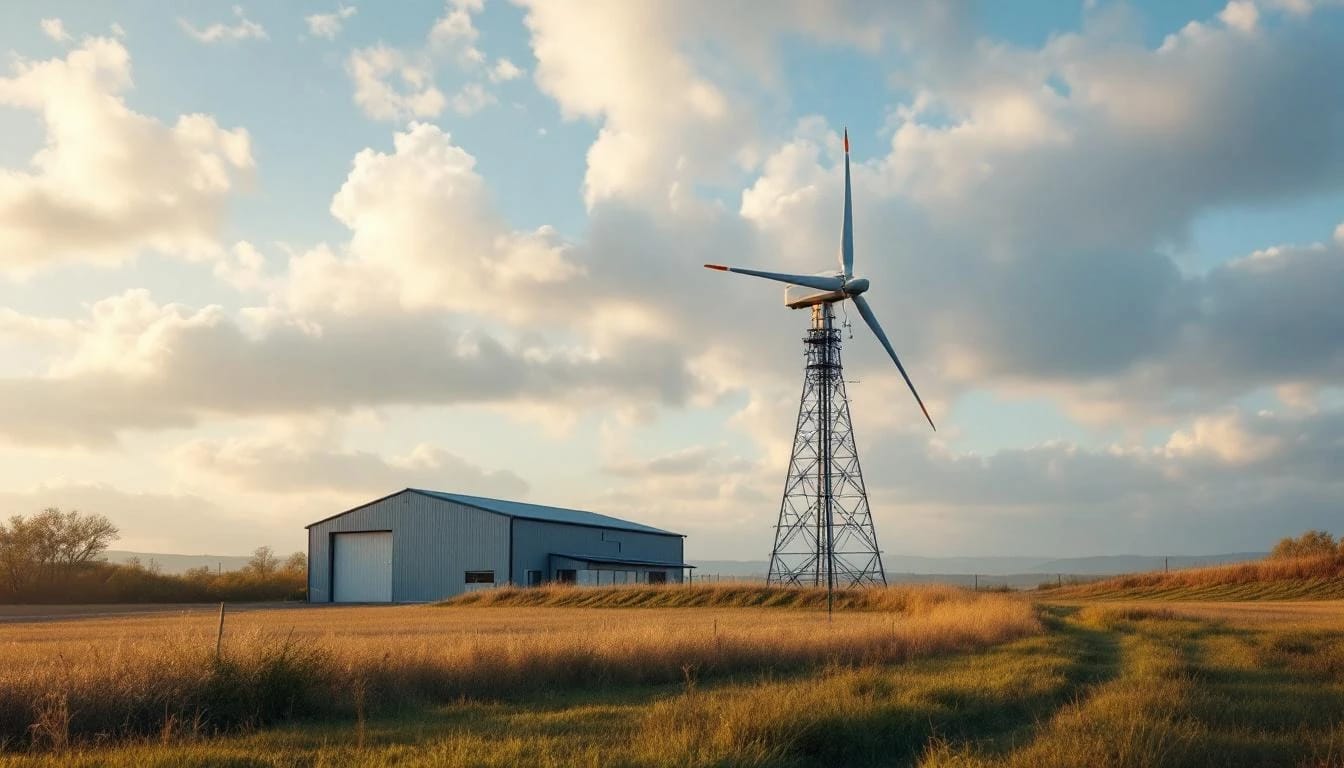
A 5 kW rated turbine produces widely different annual energy yields based on wind class. In a Class 3 site (6.4-7.0 m/s average wind speed), expect 9,000-11,000 kWh per year. Class 2 locations (5.6-6.4 m/s) typically deliver 6,000-8,500 kWh, while Class 4+ sites (above 7.0 m/s) can push output to 12,000-15,000 kWh. The average U.S. household consumes 10,500 kWh annually, so a properly sited 5 kW turbine in Class 3 wind meets 85-105% of typical residential demand. These figures assume standard hub heights of 100-120 feet and manufacturer power curves validated by third-party testing.
Understanding wind class and turbine ratings
The Department of Energy wind resource classification system divides sites into seven classes based on annual average wind speed at specific heights. Class 1 represents the lowest wind resource (below 4.4 m/s at 50 meters), while Class 7 indicates exceptional wind (above 9.4 m/s). Most residential small wind installations occur in Class 2-4 zones.
A turbine's rated capacity—the 5 kW figure—refers to peak electrical output under ideal conditions, typically achieved at wind speeds of 11-13 m/s (25-29 mph). Real-world production depends on how often winds reach those speeds and the turbine's power curve characteristics across the full speed range. The Bergey Excel 10 and similar models achieve rated output at approximately 13 m/s, while the Primus Air 40 reaches 5 kW closer to 11 m/s.
Hub height dramatically affects production. A 5 kW turbine on a 100-foot tower in Class 3 wind will produce 30-40% more energy than the identical unit on a 60-foot tower due to wind shear—the increase in wind speed with elevation. The Department of Energy Small Wind Guidebook emphasizes that tower height matters more than swept area for most residential applications.
![INLINE: Wind resource map showing Class 2-4 zones across continental United States with height-corrected contours]
Class 2 wind sites: 5.6-6.4 m/s average
Class 2 sites represent marginal wind resources where careful evaluation determines economic viability. At 5.6 m/s average (12.5 mph), a 5 kW turbine produces approximately 6,000-7,200 kWh annually. At the upper Class 2 boundary of 6.4 m/s (14.3 mph), output climbs to 7,800-8,500 kWh.
These locations cover much of the southeastern United States, portions of the Pacific Northwest below ridge lines, and inland areas shielded by terrain. A Skystream 3.7 (2.4 kW rated, but using 5 kW equivalent calculations) operating in Class 2 wind at 100 feet might generate 4,800 kWh—48% of the 10,000 kWh average home consumption.
The economics shift significantly in Class 2 zones. With the federal 30% Residential Clean Energy Credit (IRC §25D), a $35,000-$42,000 installed system (turbine, tower, installation, electrical integration) receives $10,500-$12,600 in tax credits. Annual production worth $720-$1,020 (at $0.12/kWh) yields a 20-30 year simple payback before the credit, or 14-21 years after the federal incentive. State-specific programs through the DSIRE database can further reduce payback periods.
Class 2 installations benefit from hybrid approaches. Pairing a 5 kW wind turbine with 3-5 kW of solar photovoltaics smooths seasonal production gaps—wind peaks in winter and spring while solar dominates summer months. NEC Article 705 governs interconnection requirements for these combined systems, and a licensed electrician must design the point-of-common-coupling to prevent simultaneous contribution exceeding service panel ratings.
Class 3 wind sites: 6.4-7.0 m/s average
Class 3 locations represent the sweet spot for residential 5 kW turbines. Annual production ranges from 9,000 kWh (at 6.4 m/s) to 11,000 kWh (at 7.0 m/s). A properly sited installation meets or exceeds average household consumption, potentially zeroing out annual electric bills under net metering arrangements.
The Great Plains states, upper Midwest ridges, Wyoming basins, coastal Oregon and Washington, and exposed hilltops across Appalachia typically qualify as Class 3. The Bergey Excel 10 (10 kW rated) scaled to equivalent 5 kW output produces 9,200-9,800 kWh in these conditions based on manufacturer-specified power curves and third-party validation.
Monthly production varies substantially. January through April typically deliver 35-40% of annual output as storm systems bring sustained winds. June through August contribute only 15-20% due to lighter thermal circulation patterns. A 5 kW turbine in 6.7 m/s average wind might generate 1,200 kWh in March but only 550 kWh in July. Grid connection with net metering (where available) balances this seasonal mismatch—excess spring production credits offset summer shortfalls.
Tower height optimization matters less in Class 3 sites but remains significant. Moving from 80 feet to 120 feet adds 800-1,200 kWh annually—an 8-12% gain. However, FAA Part 77 notification requirements trigger at 200 feet above ground level (or less near airports), and local zoning often restricts heights to 100-120 feet in residential zones. The incremental production gain rarely justifies towers above 120 feet for 5 kW turbines once structural costs and permitting complexity enter calculations.
Class 4 and higher: 7.0+ m/s average
Class 4 sites (7.0-7.5 m/s) push 5 kW turbine production to 12,000-13,500 kWh annually. Class 5 (7.5-8.0 m/s) can achieve 14,000-15,000 kWh. These exceptional residential locations occur on exposed ridge lines, open plains with minimal surface roughness, and coastal bluffs with offshore fetch.
At these production levels, a single 5 kW turbine generates 115-145% of average household consumption. Surplus generation under net metering policies (varying by state and utility) may credit at retail or wholesale rates depending on jurisdiction. Some utilities cap annual net excess generation (NEG) compensation, effectively limiting the economic benefit of oversized production. Before installation, verify utility interconnection agreements and state policies through DSIRE.
High wind sites create additional engineering considerations. Turbine survivability becomes paramount—machines must withstand occasional gusts to 50-60 m/s (112-134 mph) without structural failure. The Aeolos-H 5 kW and Pikasola 5000W models specify survival wind speeds of 50-55 m/s, while premium Bergey units tolerate 60 m/s. Under-specifying turbine survivability in Class 4+ wind risks catastrophic failure during severe weather events.
Turbulence intensity also increases with wind speed and complex terrain. The IEC 61400-2 small wind turbine standard defines turbulence categories (A, B, C), with Category A representing the highest turbulence. Class 4+ ridge-top sites frequently exhibit Category A conditions, requiring turbines designed for these stresses. Manufacturer specifications should explicitly state IEC class compliance—models certified only for Class B or C turbulence may experience premature mechanical failure in high-turbulence environments.
Capacity factor: the key production metric
Capacity factor expresses actual energy production as a percentage of theoretical maximum output if the turbine ran at rated capacity continuously. A 5 kW turbine operating 24/7 for a year would generate 43,800 kWh (5 kW × 8,760 hours). Real-world production of 9,000 kWh represents a 20.5% capacity factor (9,000 ÷ 43,800).
Small wind turbines in residential applications achieve:
- Class 2: 14-19% capacity factor
- Class 3: 20-25% capacity factor
- Class 4: 27-31% capacity factor
- Class 5+: 32-38% capacity factor
These figures lag behind utility-scale wind farms (35-45% capacity factors) due to lower hub heights, higher turbulence from surface obstacles, and less sophisticated turbine designs. However, small turbines offset this through distributed generation benefits—energy produced on-site avoids 6-8% transmission and distribution losses inherent in grid power.
The power curve shape influences capacity factor as much as average wind speed. Turbines with lower cut-in speeds (the minimum wind speed for rotation) and efficient generation at 4-8 m/s capture more energy hours. The Primus Air 40 cuts in at 3 m/s versus 3.5 m/s for the Skystream 3.7—a seemingly minor difference that adds 400-600 kWh annually in marginal wind sites.
Real-world factors that reduce production
Theoretical calculations assume perfect conditions. Actual installations encounter losses:
Downtime and maintenance: Annual turbine availability averages 95-98% after the break-in period. Scheduled maintenance, weather-related shutdowns, and occasional repairs reduce production by 2-5%.
Wake effects and obstacles: Trees, buildings, and terrain within 500 feet of the turbine create turbulent wake zones. A barn 150 feet upwind (in the prevailing wind direction) reduces annual production by 15-25%. The rule of thumb places turbines 30 feet above any obstacle within 500 feet, but many residential sites cannot achieve this clearance for all wind directions.
Electrical losses: Rectification, inversion, and wire resistance consume 3-6% of generated energy before reaching the home service panel. Longer wire runs from tower to inverter increase these losses—using appropriately sized conductors (typically 4-2 AWG for 5 kW turbines depending on distance) per NEC Article 310 minimizes voltage drop.
Icing and snow: Northern climates experience production losses during icing events when blade surfaces accumulate ice, disrupting aerodynamics. Some turbines include heating elements or ice-detection shutdowns. Annual ice-related losses range from negligible in temperate zones to 5-8% in Minnesota, Montana, and similar climates.
Grid curtailment: Net metering systems occasionally disconnect during grid faults or frequency excursions. While uncommon, these events cost 0.5-1.5% of annual production. Off-grid systems with battery storage avoid this loss but incur round-trip storage inefficiency of 15-20%.
Combining these factors, real-world production typically falls 12-18% below theoretical calculations based on wind resource alone. A Class 3 site projecting 10,000 kWh from wind data might actually deliver 8,500-9,200 kWh after accounting for all practical losses.
Comparing 5 kW models across wind classes
| Model | Rated Power | Cut-in Speed | Class 2 Output | Class 3 Output | Class 4 Output | Survival Speed |
|---|---|---|---|---|---|---|
| Bergey Excel 10 | 10 kW | 3.6 m/s | 8,200 kWh | 11,500 kWh | 15,200 kWh | 60 m/s |
| Primus Air 40 | 5 kW | 3.0 m/s | 6,800 kWh | 9,400 kWh | 12,600 kWh | 50 m/s |
| Aeolos-H 5kW | 5 kW | 3.5 m/s | 6,200 kWh | 8,900 kWh | 11,800 kWh | 50 m/s |
| Skystream 3.7 | 2.4 kW | 3.5 m/s | 3,600 kWh | 5,100 kWh | 6,800 kWh | 58 m/s |
Output figures represent estimated annual production at 100-foot hub height with typical loss factors. Manufacturer-specified data where available; otherwise calculated from published power curves.
The Bergey Excel 10, though rated at 10 kW, operates effectively as a high-output option for the 5 kW class when de-rated through inverter limits or battery bank sizing. Its larger rotor (7-meter diameter versus 2.5-3.5 meters for true 5 kW machines) captures more energy at lower wind speeds, particularly benefiting Class 2 sites.
Chinese-manufactured units (Aeolos, Pikasola) offer lower upfront costs—$8,000-$12,000 for turbine and controller versus $18,000-$25,000 for Bergey or Primus. However, these savings often come with shorter warranties (2-5 years versus 10-20 years), limited U.S.-based technical support, and less rigorous third-party certification. Small wind certification through the Small Wind Certification Council (SWCC) or equivalent validates performance claims but adds cost that budget manufacturers sometimes skip.
Financial returns across wind classes
Installation costs for 5 kW turbines range from $32,000 to $48,000 depending on:
- Turbine selection and warranty
- Tower height and foundation requirements
- Site preparation and crane access
- Electrical integration complexity
- Permit and interconnection fees
Apply the federal 30% Residential Clean Energy Credit (IRC §25D) through IRS Form 5695, reducing effective cost to $22,400-$33,600. State incentives vary—check DSIRE for current programs. Some states offer additional rebates (Massachusetts, New York, Oregon have historically provided $0.50-$1.50 per watt), sales tax exemptions, or property tax abatements.
Class 2 economics: 7,000 kWh annually at $0.12/kWh = $840 value. After federal credit on $38,000 system ($26,600 net), payback extends to 32 years. Electricity rate escalation of 3%/year improves returns, but Class 2 sites rarely achieve compelling economics on energy savings alone. Environmental benefits and energy independence motivate most Class 2 installations.
Class 3 economics: 10,000 kWh annually at $0.12/kWh = $1,200 value. Net system cost $27,300, payback 23 years. With 3% annual rate increases, effective payback drops to 17-18 years. These systems begin approaching economic viability, particularly where utility rates exceed $0.14/kWh (California, Hawaii, New England).
Class 4 economics: 13,000 kWh annually at $0.12/kWh = $1,560 value. Net system cost $28,500, payback 18 years, or 14 years with rate escalation. Class 4+ sites offer the strongest financial case, especially in high-rate territories where effective payback falls below 12 years.
These calculations ignore maintenance costs (approximately $150-$300 annually), insurance riders ($75-$200/year), and eventual inverter replacement ($1,800-$3,200 at 10-12 years). A comprehensive pro forma includes these expenses.
Measuring your site before committing
Wind resource estimates from national databases provide starting points but lack site-specific accuracy. The Department of Energy WINDExchange Small Wind Guidebook recommends on-site measurement for installations above $20,000. A data-logging anemometer mounted at proposed hub height for 12 months costs $1,500-$3,500 (equipment, tower rental, data analysis) but eliminates guesswork.
Shorter measurement periods introduce uncertainty. A 3-month winter measurement might overestimate annual production by 20-30% if those months coincidentally featured above-average storm activity. Conversely, a summer-only measurement may underestimate by 25-35%. Full-year data captures seasonal variation and identifies turbulent conditions from nearby obstacles.
Professional wind resource assessment costs $4,000-$8,000 but includes computational fluid dynamics modeling around obstacles, vertical wind shear calculations, and turbulence intensity analysis. For borderline Class 2/3 sites where production projections determine go/no-go decisions, this investment provides confidence.
Alternatively, several installers offer production guarantees. For an upfront premium or higher total system cost, the installer commits to minimum annual kWh output and compensates shortfalls. These guarantees shift performance risk to the installer but typically inflate system cost by 8-15% to cover the risk premium and measurement expenses the installer absorbs.
What wind speed produces maximum output from a 5 kW turbine?
Most 5 kW turbines reach rated output at 11-13 m/s (25-29 mph) and hold that production through 14-16 m/s. Above 16 m/s, many models begin furling (feathering blades) to prevent over-speed. The Bergey Excel reaches 5 kW output equivalent at approximately 10.5 m/s, while the Aeolos-H 5kW requires 13 m/s. Optimal production occurs when winds consistently blow in the 8-14 m/s range where turbines operate near maximum efficiency without triggering protective shutdowns.
Can a 5 kW turbine power a whole house?
In Class 3+ wind, a 5 kW turbine generating 9,000-13,000 kWh annually matches or exceeds the 10,500 kWh average U.S. household consumption. However, instantaneous power matters for off-grid applications. A 5 kW turbine produces 5 kW only during optimal winds; during calm periods it generates nothing. Grid-connected systems with net metering balance production and consumption across time. Off-grid systems require battery storage sized for 3-7 days of autonomy, adding $8,000-$18,000 to system cost.
How does terrain affect a 5 kW turbine output?
Flat, open terrain with low surface roughness (grassland, water, desert) preserves wind energy and reduces turbulence. Forested areas or urban settings increase surface roughness, slowing winds near ground level and creating turbulence that reduces production and increases mechanical wear. A turbine in open Class 3 terrain at 100 feet might experience effective Class 4 wind speeds, while the same Class 3 site in a forested valley drops to effective Class 2 conditions. Hilltop installations accelerate winds by 10-20% compared to valley floors, potentially elevating a Class 2 resource to Class 3 performance.
Do vertical-axis turbines produce the same as horizontal-axis in different wind classes?
Vertical-axis wind turbines (VAWTs) typically achieve 40-60% of the energy production of equivalent-rated horizontal-axis turbines (HAWTs) due to lower efficiency coefficients and higher drag losses. A 5 kW rated VAWT in Class 3 wind produces 4,500-6,600 kWh versus 9,000-11,000 kWh for a HAWT. VAWTs offer advantages in turbulent urban environments and simplified tower designs, but these benefits rarely offset the production penalty. Commercial VAWT manufacturers often overstate capacity ratings, so verify output through third-party testing data.
What happens during wind speeds above the turbine's rating?
Turbines employ overspeed protection through passive furling (blade pitch changes from centrifugal force), active pitch control (electric motors feather blades), or electrical braking (shorting generator windings creates drag). Above the furling speed (typically 14-18 m/s for 5 kW machines), output plateaus or declines as the system protects itself. During extreme winds exceeding 25 m/s, most turbines fully brake and lock to prevent structural damage. Annual production from winds above rated speed contributes only 5-12% of total output since these conditions occur infrequently even in Class 4 sites.
Bottom line
A 5 kW wind turbine delivers dramatically different annual energy depending on wind class—6,000-8,500 kWh in Class 2, 9,000-11,000 kWh in Class 3, and 12,000-15,000 kWh in Class 4+. Class 3 sites represent the minimum viable resource for most residential installations when combined with the federal 30% tax credit. Measure your specific site for 12 months or commission a professional wind assessment before committing $30,000-$45,000 to a complete system. Connect with installers certified by NABCEP or equivalent and verify all electrical work follows NEC Article 705 standards through a licensed electrician.
Share this article
windturbinehome.com/s/91b956
Editorial note: This article was researched and written by a member of the Wind Turbine Home editorial team. AI-assisted tools were used for spell-checking and light grammar review only — all research, analysis, and conclusions are our own. Our editorial policy prohibits sponsored content and paid placements. Read our editorial policy →
Related reading
small wind turbines
Furling vs Pitch Control on Small Wind Turbines: Rotor Protection Explained
Small wind turbines use furling or pitch control to protect rotors in high winds. Furling turns the turbine sideways; pitch feathers the blades. Compare costs, reliability, and best applications.
small wind turbines
Capacity Factor for Small Wind Turbines: Realistic Numbers by Site
Most residential wind turbines deliver 10–25% capacity factor in average sites, 25–35% in excellent wind. Learn what those numbers mean for your energy bills.

small wind turbines
Tip Speed Ratio for Residential Turbines: What to Spec
Tip speed ratio determines how efficiently your small wind turbine extracts energy. Learn optimal TSR ranges for HAWT vs VAWT, why it matters for residential installs, and how to match turbine specs to your site conditions.
small wind turbines
Betz Limit Explained: Why No Turbine Extracts More Than 59.3%
The Betz limit proves no wind turbine can convert more than 59.3% of wind's kinetic energy into electricity—a fundamental physics constraint that shapes every rooftop and backyard turbine design.
small wind turbines
IEC 61400-2 Standard Explained: Small Wind Turbine Safety Guide
IEC 61400-2 sets the global safety and performance rules for wind turbines under 200 kW. This guide explains certification requirements, structural tests, and what compliance means for U.S. homeowners.
small wind turbines
Best Small Wind Turbines 1kW-10kW for Homes (2026 Guide)
Compare the top small wind turbines from 1kW to 10kW for residential properties. Real-world output, installed costs, and manufacturer specs—updated 2025.

small wind turbines
Permanent Magnet vs Induction Wind Generator: Which to Spec
Permanent magnet generators dominate residential wind turbines because they self-excite at low RPM and need no grid connection, while induction generators require grid tie and higher wind speeds.
small wind turbines
Best 3 kW Home Wind Turbines 2026: Cost and ROI Compared
Real prices, installation costs and payback for the Bergey Excel 1, Primus Air 40 and Aeolos-H 3kW, so US homeowners see which 3 kW turbine is worth it.
small wind turbines
5 kW Home Wind Turbine Systems: Brands, Output & Costs 2026
Five-kilowatt residential wind turbines cost $15,000–$40,000 installed. Compare Bergey Excel, Primus Air, and certified brands for output, tower height, and grid-tie options.