Best 3 kW Home Wind Turbines 2026: Cost and ROI Compared
Real prices, installation costs and payback for the Bergey Excel 1, Primus Air 40 and Aeolos-H 3kW, so US homeowners see which 3 kW turbine is worth it.
Share this article
windturbinehome.com/s/a0cacc
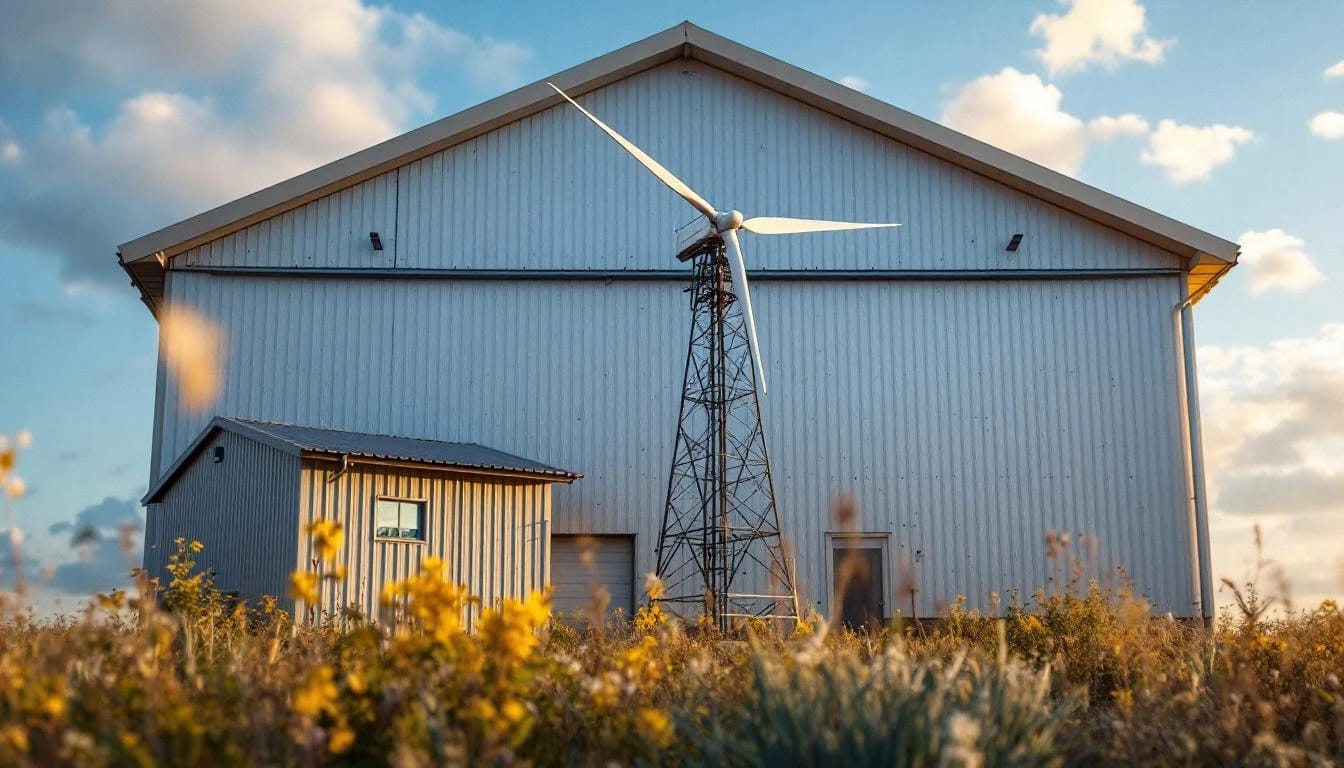
A quality 3 kW home wind turbine costs between $8,500 and $18,000 before installation, with total project budgets landing in the $15,000–$35,000 range depending on tower height, electrical work, and site preparation. For residential properties with average wind speeds above 5 m/s (11 mph), a properly sized 3 kW system can offset 30–60% of a typical home's electricity consumption while qualifying for the federal 30% Residential Clean Energy Credit under IRC §25D. The sweet spot sits between underpowered 1 kW units that disappoint and overbuilt 10 kW turbines that cost more than most rooftop solar arrays while producing less predictable output.
Why the 3 kW class dominates residential installations
The 3 kW category represents the highest capacity most homeowners can install without triggering additional permitting hurdles, neighborhood pushback, or the need for commercial-grade infrastructure. Most jurisdictions classify systems under 5 kW as "accessory structures," streamlining the approval process compared to larger machines. Rotor diameters stay modest—typically 3.5 to 5 meters—so transport and crane costs remain manageable.
Three kilowatts of rated capacity translates to roughly 300–600 kWh per month in locations with 5–6 m/s average wind speeds at hub height. That production window matches the needs of energy-efficient homes or provides meaningful supplemental power for larger properties. Push beyond 3 kW and you enter the realm of agricultural or light-commercial systems with tower requirements, foundation engineering, and maintenance schedules that exceed what most residential budgets and skill sets can accommodate.
The NEC Article 705 interconnection requirements for systems under 10 kW are straightforward enough that many electricians comfortable with solar PV can handle the integration without specialized training. Inverters and controllers in this power range use standard residential electrical components rather than three-phase industrial gear.
Performance expectations grounded in physics
Wind power scales with the cube of wind speed, meaning a site with 6 m/s average winds delivers 2.37 times more energy than a 5 m/s location—not 20% more. This cubic relationship explains why professional site assessments matter more than equipment specifications. A $15,000 turbine at a marginal site will always underperform a $10,000 unit in a clean wind corridor.
Expect 15–25% capacity factor in typical residential settings. That means a 3 kW turbine produces its full rated output only during strong wind events, averaging 450–750 watts over the course of a year. Sites with consistent winds above 5.5 m/s at hub height and minimal turbulence from buildings or trees can push capacity factors toward 30%, while heavily obstructed suburban lots often struggle to break 12%.
Vertical-axis wind turbines (VAWTs) frequently advertised for rooftops carry lower cut-in wind speeds but also lower overall efficiency. Physics limits their power coefficient to roughly 35% of the Betz limit, compared to 45–50% for horizontal-axis designs. Rooftop mounting introduces destructive vibration and turbulence effects that void most warranties. Ground-mounted horizontal-axis turbines on proper towers consistently outperform roof-mounted VAWTs by 3:1 or more in side-by-side testing.
Top value picks for American residential sites
Bergey Excel 1 (1 kW rated, 2.5m rotor)
The Bergey Excel 1 occupies the high-end of the 1 kW class with proven reliability spanning three decades. Its actual peak output reaches 1.5 kW in strong winds, positioning it as an entry-level alternative to true 3 kW machines. Turbine cost runs $6,800–$7,500, with complete installations on 60-foot tilt-up towers landing around $18,000–$22,000.
Bergey's permanent-magnet alternator eliminates brushes and slip rings, cutting maintenance to annual bolt checks and bearing inspection every five years. The wild-AC design sends variable-frequency three-phase power directly to a grid-tie inverter without intermediate rectification, improving efficiency by 4–6% compared to DC-coupled systems. Twenty-year warranties on structural components reflect genuine engineering confidence rather than marketing posture.
Output in 5.5 m/s average wind conditions: 150–225 kWh/month. Best suited for off-grid cabins, backup power scenarios, or supplemental generation on small lots where a larger turbine would face setback restrictions.
Primus Air 40 (2.5 kW rated, 4.2m rotor)
The Primus Air 40 bridges the gap between 1 kW entry systems and full 3 kW workhorses. Dutch engineering emphasizes quiet operation through careful blade profiling—sound levels stay under 38 dBA at 5 meters, comparable to a refrigerator. Turbine pricing sits at $11,000–$13,000, with turnkey installations running $21,000–$28,000 depending on tower selection and site complexity.
The larger rotor diameter captures more energy at lower wind speeds, with meaningful production starting around 3 m/s. Real-world output in 5 m/s conditions averages 280–350 kWh monthly. The hinged tower base allows one-person lowering for maintenance, eliminating the need for equipment rental or contractor visits for routine service.
Primus ships with a grid-tie inverter sized specifically for the turbine's output characteristics, avoiding the efficiency losses and compatibility headaches that plague mix-and-match component systems. Ten-year factory warranty covers both turbine and inverter. Best choice for suburban properties where noise ordinances limit options or sites with moderate but consistent winds.
Aeolos-H 3 kW (3 kW rated, 4.5m rotor)
Aeolos-H 3 kW units deliver the lowest cost per rated watt in the category: $6,200–$7,800 for the turbine, $14,000–$24,000 fully installed. Chinese manufacturing keeps prices down while CE certification provides baseline quality assurance. The three-blade horizontal-axis design uses a proven layout with electromagnetic braking and furling overspeed protection.
Output specifications claim 300–400 kWh monthly at 5 m/s average wind speeds, though field reports suggest the lower end of that range is more realistic. The included charge controller and inverter handle both battery-based and grid-tie configurations. Five-year warranty coverage focuses on major components (blades, alternator, controller) rather than the comprehensive protection offered by premium brands.
Installation costs vary widely because Aeolos sells direct rather than through dealer networks with standardized installation practices. Buyers who source their own towers and handle permitting can complete projects for under $15,000 total, while turnkey installations through third-party contractors push budgets toward $24,000. Best value proposition for hands-on owners comfortable managing subcontractors and navigating municipal approval processes independently.
Pikasola 3 kW Wind Turbine (3 kW rated, 5.0m rotor)
Pikasola occupies the budget end with turbines priced $4,500–$6,200 and complete installations achievable for $12,000–$18,000. The larger 5-meter rotor compensates for lower-efficiency blade profiles, capturing adequate energy despite less sophisticated aerodynamics. Five-blade configuration reduces rotational speed and noise at the cost of reduced peak efficiency.
Quality control inconsistencies mark the primary concern: some units operate trouble-free for years while others require blade rebalancing, bearing replacement, or controller repairs within 18 months. The one-year warranty provides minimal protection given component lead times from overseas suppliers. Electrical integration sometimes requires aftermarket modifications when the included inverter proves incompatible with utility interconnection standards.
Pikasola makes sense for experimental installations, off-grid systems where grid-tie approval isn't a factor, or buyers willing to accept higher maintenance involvement in exchange for upfront savings. Not recommended for primary-home power generation where reliability matters.
Installation cost breakdown and hidden expenses
Turbine purchase represents 35–50% of total project cost. Tower selection drives the next major expense: tubular steel monopoles with concrete foundations run $4,000–$8,000 for 60–80 foot heights, while tilt-up lattice towers with guy wires cost $3,000–$5,500 but require larger clear areas for the guy wire anchor points.
Electrical work adds $2,500–$6,000 depending on the distance between turbine and main service panel, whether trenching crosses landscaping or paved areas, and local code requirements for disconnects and metering equipment. NEC Article 705 mandates dedicated disconnect switches, and many utilities require separate production meters even for net-metered systems.
Professional installation labor runs $3,000–$7,000 when hiring contractors experienced with small wind systems. General handymen or solar installers without wind-specific knowledge often underestimate the precision required for tower plumb alignment and guy wire tensioning, leading to shortened equipment life or catastrophic failures during high-wind events.
Permit fees vary wildly: $150–$400 in rural counties with streamlined processes, $800–$2,500 in suburban jurisdictions requiring engineering stamps, environmental reviews, and public hearings. FAA Part 77 notification is required for any structure exceeding 200 feet AGL or located near airports; most residential 3 kW installations stay well below that threshold but confirming status costs nothing and prevents expensive surprises.
Plan for $500–$1,200 in site assessment and engineering costs if your property has unusual soil conditions, significant slope, or obstacles that create complex wind patterns. Professional assessment pays for itself by preventing installation in locations where turbulence will limit performance or destroy equipment prematurely.
Comparing 3 kW turbines to residential solar
| Criterion | 3 kW Wind Turbine | 3 kW Solar Array |
|---|---|---|
| Installed cost | $15,000–$35,000 | $6,500–$9,500 |
| Annual output (typical) | 3,600–7,200 kWh | 3,900–4,500 kWh |
| Output seasonality | Higher winter production | Higher summer production |
| Maintenance frequency | Annual inspection, 5-year bearing service | Minimal, occasional cleaning |
| Noise generation | 35–50 dBA at property line | Silent |
| Permitting complexity | Moderate to high | Low to moderate |
| Federal tax credit | 30% IRC §25D | 30% IRC §25D |
| Useful life | 15–25 years | 25–30 years |
Wind makes economic sense when your site has documented average winds above 5.5 m/s at hub height, sufficient setback space for tall towers, and either high winter electricity consumption or time-of-use rates that value evening production. Solar wins on simplicity and predictability for most suburban and urban properties.
Combining both technologies creates complementary seasonal production: solar peaks in summer when air conditioning drives demand, while wind typically strengthens during winter months when heating loads dominate and solar output drops. Hybrid systems require careful attention to electrical design because both sources must share the same service panel capacity and utility interconnection limits.
Regional incentive programs and financing
The federal IRC §25D Residential Clean Energy Credit covers 30% of equipment and installation costs for wind systems placed in service through 2032, then steps down to 26% in 2033 and 22% in 2034. No cap exists on the credit amount, but it's non-refundable—you must have sufficient tax liability to claim the full benefit, though unused portions carry forward.
File IRS Form 5695 with your tax return and maintain detailed receipts for all qualified expenses including equipment, labor, permits, and electrical work. The credit covers only your primary or secondary residence, not rental properties or business locations.
State and utility incentives vary dramatically. The Database of State Incentives for Renewables & Efficiency (DSIRE) provides current program details, but California's SGIP program, New York's NY-Sun initiative, and Massachusetts' SMART program generally focus solar funding with minimal wind-specific support. Rural electric cooperatives sometimes offer better wind incentives than investor-owned utilities.
Production-based incentives that pay per kWh generated favor wind over solar in strong wind regions, since wind capacity factors can exceed solar in the right locations. Some programs cap payments at system sizes below 5 kW, making 3 kW installations eligible while larger systems get cut off.
Property tax exemptions for renewable energy systems exist in 37 states but usually exclude the value added by the installation from property tax assessments rather than providing direct bill credits. Check county assessor rules—some jurisdictions consider towers and foundations taxable improvements even when the turbine itself is exempt.
Critical mistakes that destroy economics
Installing without a proper wind assessment tops the list of expensive errors. Consumer-grade handheld anemometers and smartphone apps lack the accuracy and sustained measurement period needed for reliable projections. Professional assessment using calibrated instruments mounted at proposed hub height for 6–12 months costs $800–$2,000 but prevents investing $25,000 in a turbine that will underperform by 50% or more.
Undersizing the tower to save money guarantees disappointing results. Wind speed increases with height following a logarithmic curve, and turbulence from ground obstacles diminishes dramatically above 60 feet. The price difference between a 40-foot tower ($2,800) and 70-foot tower ($5,200) seems substantial until you calculate that the taller tower delivers 40–70% more annual energy production.
Choosing equipment based solely on rated capacity ignores the real-world performance curve. A turbine rated at 3 kW might produce that output at 12 m/s wind speeds—conditions that occur perhaps 5% of the time—while generating only 400 watts at the 5–6 m/s winds that dominate most sites. Study power curves and calculate expected annual production based on your site's wind distribution, not peak specifications.
Attempting installation without professional help saves labor cost but risks injury and equipment damage. Towers must be perfectly plumb and guy wires tensioned to precise specifications. Blade balancing affects vibration and bearing life. Electrical connections require torque specifications and proper grounding to prevent fires. One improperly set component can destroy a $12,000 turbine during its first storm.
Maintenance schedules and long-term costs
Annual inspection covers tower bolts, guy wire tension, blade condition, and electrical connections. Budget 2–4 hours for a thorough walk-around and tower climb or lowering. Retorque all fasteners to manufacturer specifications—vibration loosens hardware over time even when the turbine appears to operate normally.
Five-year major service includes bearing inspection and lubrication, brake system check, and blade leading-edge repair or coating renewal. Expect $600–$1,200 in parts and labor if hiring professionals, or $150–$300 in materials for competent DIY maintenance. Bergey and Primus publish detailed service manuals; Aeolos and Pikasola documentation is less comprehensive.
Blade replacement becomes necessary after 12–20 years depending on environmental conditions and turbine hours. Coastal sites and locations with frequent ice loading face shorter blade life. Replacement sets cost $800–$2,400. Some owners opt for performance upgrades at replacement time, installing improved blade profiles that boost output by 8–15%.
Inverter replacement averages every 10–15 years at $1,200–$2,800. Grid-tie inverters work harder than off-grid controllers because they constantly match utility frequency and voltage. Extended warranties on inverters make economic sense given replacement costs.
Lightning protection and proper grounding prevent the most expensive failures. Direct strikes occur rarely, but nearby lightning induces voltage surges that destroy controllers and inverters. Installing surge arrestors on both AC and DC sides adds $300–$500 to installation cost but prevents $3,000–$8,000 in replacement equipment and downtime.
How much electricity will a 3 kW wind turbine actually produce at my house?
Production depends entirely on your site's average wind speed at hub height. A location with 5 m/s average winds generates approximately 300–450 kWh monthly, while 6 m/s conditions produce 500–700 kWh monthly, and 7 m/s sites can reach 800–1,000 kWh monthly. These figures assume proper tower height and minimal turbulence. Most suburban properties with trees and buildings experience 4–5 m/s effective wind speeds, limiting practical production to 250–400 kWh monthly—roughly 25–40% of typical household consumption.
Can I install a 3 kW wind turbine on my roof?
Roof mounting creates destructive vibration, voids most warranties, and typically reduces output by 30–60% compared to proper tower installations due to turbulent airflow over buildings. The dynamic loads from a spinning turbine exceed structural design parameters for residential roof framing. Every reputable manufacturer explicitly prohibits roof mounting in their installation manuals. Ground-mounted towers placed away from structures deliver better performance with no risk of building damage.
What wind speed is needed to make a 3 kW turbine economically viable?
Economic viability requires average wind speeds above 5.5 m/s (12.3 mph) at hub height, local electricity rates above $0.12 per kWh, and reasonable installation costs under $25,000. At 5 m/s with $0.13/kWh electricity rates, simple payback stretches beyond 20 years. At 6.5 m/s with the same electricity cost, payback drops to 10–14 years. The federal 30% tax credit improves all scenarios significantly but can't compensate for marginal wind resources. Professional site assessment prevents expensive miscalculations.
Do I need permission from my utility company to connect a wind turbine?
Yes. NEC Article 705 governs distributed generation interconnection, but utilities add their own requirements for application approval, equipment standards, and metering configuration. Most utilities require an interconnection agreement signed before installation begins. Approval processes take 4–12 weeks. Some utilities charge application fees ($150–$500) and require additional liability insurance. Installing and connecting without approval risks disconnection, penalties, and voided manufacturer warranties. Net metering availability and compensation rates vary by utility and state, significantly affecting project economics.
How loud are 3 kW wind turbines at typical residential distances?
Properly installed horizontal-axis turbines generate 35–45 dBA at 300 feet—comparable to a quiet library or rural nighttime ambient noise. Most noise complaints stem from turbulent installations where imbalanced blades or loose hardware create thumping sounds. Tower setbacks of 1.5× tower height from property lines prevent most neighbor conflicts. Vertical-axis turbines often run quieter but produce dramatically less power. Check local noise ordinances before installation; some jurisdictions limit turbine operation to daytime hours or set strict dBA limits at property lines.
Bottom line
The best value 3 kW home wind turbine matches your specific site conditions, budget, and risk tolerance rather than following universal recommendations. Buyers with excellent wind resources and hands-on capabilities find strong value in Aeolos-H systems, while those prioritizing reliability and warranty protection should invest in Bergey Excel 1 or Primus Air 40 models despite higher upfront costs. Every installation requires professional wind assessment, proper tower height, and compliance with NEC Article 705 and local building codes. Start by measuring your site's actual wind resource for at least six months before committing to any purchase—that $1,500 assessment investment prevents $20,000 equipment mistakes.
Share this article
windturbinehome.com/s/a0cacc
Editorial note: This article was researched and written by a member of the Wind Turbine Home editorial team. AI-assisted tools were used for spell-checking and light grammar review only — all research, analysis, and conclusions are our own. Our editorial policy prohibits sponsored content and paid placements. Read our editorial policy →
Related reading
small wind turbines
Furling vs Pitch Control on Small Wind Turbines: Rotor Protection Explained
Small wind turbines use furling or pitch control to protect rotors in high winds. Furling turns the turbine sideways; pitch feathers the blades. Compare costs, reliability, and best applications.
small wind turbines
Capacity Factor for Small Wind Turbines: Realistic Numbers by Site
Most residential wind turbines deliver 10–25% capacity factor in average sites, 25–35% in excellent wind. Learn what those numbers mean for your energy bills.

small wind turbines
Tip Speed Ratio for Residential Turbines: What to Spec
Tip speed ratio determines how efficiently your small wind turbine extracts energy. Learn optimal TSR ranges for HAWT vs VAWT, why it matters for residential installs, and how to match turbine specs to your site conditions.
small wind turbines
Betz Limit Explained: Why No Turbine Extracts More Than 59.3%
The Betz limit proves no wind turbine can convert more than 59.3% of wind's kinetic energy into electricity—a fundamental physics constraint that shapes every rooftop and backyard turbine design.
small wind turbines
IEC 61400-2 Standard Explained: Small Wind Turbine Safety Guide
IEC 61400-2 sets the global safety and performance rules for wind turbines under 200 kW. This guide explains certification requirements, structural tests, and what compliance means for U.S. homeowners.
small wind turbines
What a 5 kW Turbine Produces in Different Wind Classes
A 5 kW small wind turbine generates 6,000-15,000 kWh/year depending on wind class. Class 3 sites (13-15 mph average) deliver 9,000-11,000 kWh annually—enough for most homes.

small wind turbines
Best Small Wind Turbines 1kW-10kW for Homes (2026 Guide)
Compare the top small wind turbines from 1kW to 10kW for residential properties. Real-world output, installed costs, and manufacturer specs—updated 2025.

small wind turbines
Permanent Magnet vs Induction Wind Generator: Which to Spec
Permanent magnet generators dominate residential wind turbines because they self-excite at low RPM and need no grid connection, while induction generators require grid tie and higher wind speeds.
small wind turbines
5 kW Home Wind Turbine Systems: Brands, Output & Costs 2026
Five-kilowatt residential wind turbines cost $15,000–$40,000 installed. Compare Bergey Excel, Primus Air, and certified brands for output, tower height, and grid-tie options.