Capacity Factor for Small Wind Turbines: Realistic Numbers by Site
Most residential wind turbines deliver 10–25% capacity factor in average sites, 25–35% in excellent wind. Learn what those numbers mean for your energy bills.
Share this article
windturbinehome.com/s/a5dda7
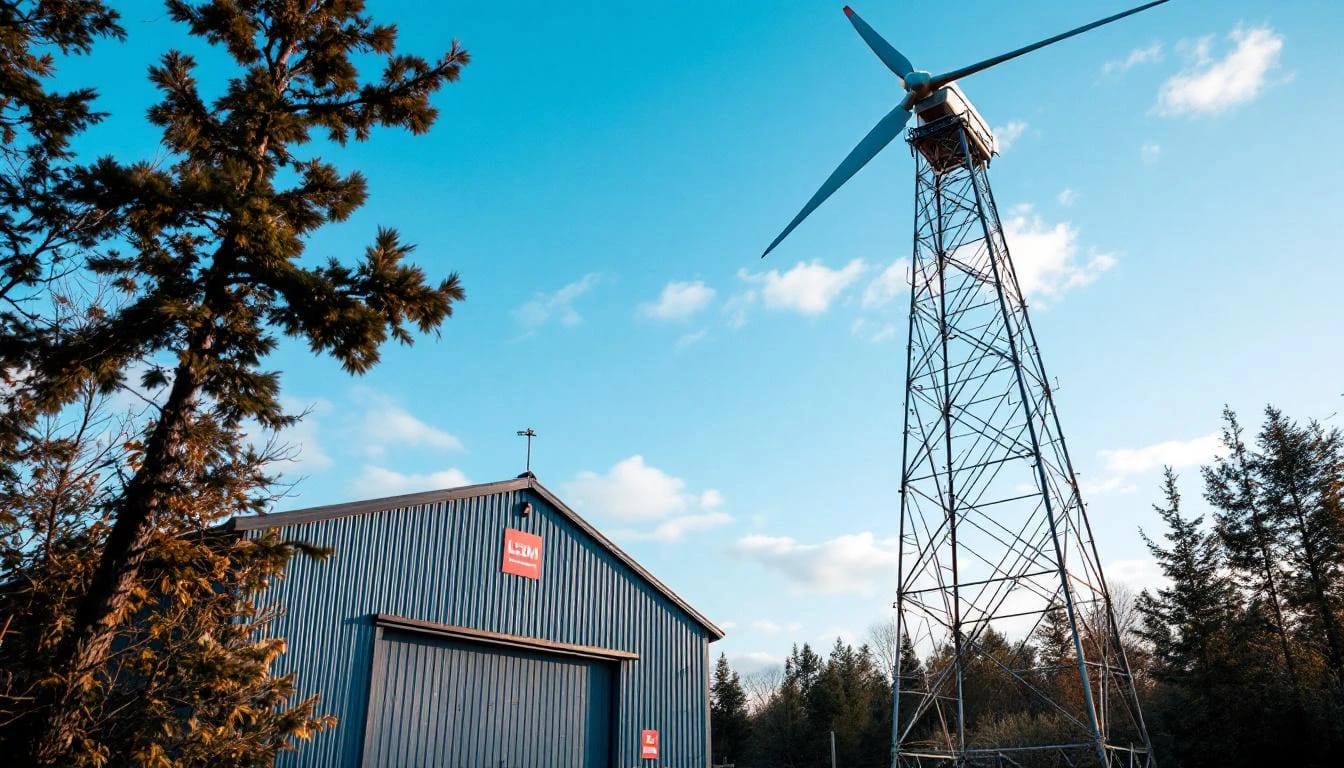
A small wind turbine's capacity factor tells you how much electricity it actually produces compared to its nameplate rating. Most residential turbines achieve 10–25% capacity factor in typical suburban and rural sites, while excellent ridge-top or coastal locations can push 25–35%. That 5 kW turbine on your property will generate between 4,380 kWh and 10,950 kWh annually—not the theoretical 43,800 kWh that a perfect 100% capacity factor would deliver. The gap between marketing claims and real-world performance hinges on your site's wind speed, turbulence, tower height, and local terrain.
What capacity factor actually measures
Capacity factor expresses annual energy production as a percentage of what a turbine would produce running at full rated power every hour of the year. A 3 kW turbine with a 20% capacity factor generates 5,256 kWh over 12 months (3 kW × 8,760 hours × 0.20). The metric collapses months of variable wind into a single efficiency number.
Most homeowners fixate on peak output—the 5 kW or 10 kW stamped on the sales brochure. Capacity factor exposes the difference between that best-case scenario and the electricity meter's reality. A turbine rated at 5 kW but operating at 15% capacity factor produces the same annual energy as a 750-watt turbine running continuously. Understanding this distinction prevents disappointment when the first utility bill arrives.
The National Renewable Energy Laboratory's distributed wind research confirms that small turbines face steeper performance penalties than utility-scale machines. Residential sites suffer from ground-level turbulence, inadequate tower heights, and intermittent low-speed winds that keep blades turning but contribute minimal power. A 400 kW commercial turbine on a 60-meter tower in Kansas can hit 35–40% capacity factor; your backyard 5 kW unit on a 30-foot pole will struggle to reach half that figure.
Site wind speed controls everything
Annual average wind speed at hub height determines capacity factor more than any other variable. The relationship is cubic: double the wind speed, and available power increases eightfold. A site averaging 5.0 m/s (11.2 mph) at 10 meters might yield 12–15% capacity factor, while a ridge-top location averaging 6.5 m/s (14.5 mph) pushes 25–30%.
| Average Wind Speed (10 m) | Typical Capacity Factor | Annual Energy (5 kW Turbine) |
|---|---|---|
| 4.5 m/s (10.1 mph) | 8–12% | 3,500–5,260 kWh |
| 5.5 m/s (12.3 mph) | 15–20% | 6,570–8,760 kWh |
| 6.5 m/s (14.5 mph) | 25–30% | 10,950–13,140 kWh |
| 7.5 m/s (16.8 mph) | 32–38% | 14,016–16,644 kWh |
These figures assume a properly sited horizontal-axis turbine on a tower tall enough to clear ground turbulence—typically 30 feet above any obstacle within 500 feet. Real installations rarely meet that ideal. Suburban homes surrounded by trees, two-story houses creating wind shadows, and ridge lines blocking prevailing winds all degrade the numbers in the middle two columns.
The NREL WindWatts tool uses modern computational models to estimate site-specific wind resources, accounting for terrain, surface roughness, and seasonal patterns. Homeowners can input GPS coordinates and receive a predicted capacity factor range before spending $15,000–$40,000 on hardware and installation. A five-minute online exercise beats guessing.
Tower height matters more than turbine size
Mounting a small wind turbine on a short pole is the fastest way to throw money away. Wind speed increases logarithmically with height; surface friction from grass, crops, and buildings slows airflow at ground level. A 5 kW Bergey Excel on a 100-foot tower in a Class 3 wind site (6.5 m/s at 10 m) will outperform the same turbine on a 40-foot pole by 60–80% in annual energy production.
Manufacturers specify capacity factor at a standard hub height—often 30 meters (98 feet) for small turbines. Few residential installations reach that mark. Zoning restrictions, FAA Part 77 notices (required for structures exceeding 200 feet within certain airport radii), and budget constraints push towers down to 60–80 feet. Each 10-foot reduction costs 5–8% of potential energy yield.
Vertical-axis wind turbines suffer additional penalties. VAWTs excel in turbulent, low-speed urban environments where horizontal-axis machines stall, but their capacity factors rarely exceed 10–15% even in rated wind conditions. A 2 kW Pikasola VAWT on a flat suburban roof will generate 1,750–2,600 kWh annually—useful for offsetting vampire loads and charging batteries, less impressive for whole-home electricity.
Guyed lattice towers deliver better performance per dollar than freestanding monopoles. A 100-foot guyed tower for a 5 kW turbine costs $8,000–$12,000 installed; a tilt-up design allows one-person maintenance. The same height in a freestanding monopole runs $18,000–$25,000 and requires a crane for blade service. The capacity factor difference? Zero, if both place the turbine at the same hub height.
Turbulence kills efficiency
Smooth, laminar wind flow allows turbine blades to extract maximum energy. Turbulence—chaotic eddies and gusts caused by buildings, trees, and terrain features—reduces capacity factor by forcing the turbine to operate off its optimal tip-speed ratio. A residential site with high turbulence intensity (above 15%) can cut capacity factor by one-third compared to a clean-air location with the same average wind speed.
The International Electrotechnical Commission's IEC 61400-2 small wind turbine standard defines four turbulence categories. Most suburban and wooded rural sites fall into Category B (turbulence intensity 16–18%), while open farmland and coastal locations qualify as Category A (below 16%). Manufacturers certify turbines to specific categories; installing a Category A machine in a Category B site voids warranties and accelerates bearing wear.
Ridge tops, coastal bluffs, and agricultural plains offer the lowest turbulence. Trees act as giant friction generators, slowing wind and creating vortices for hundreds of feet downwind. A turbine placed 300 feet from a mature oak grove will see 20–30% lower capacity factor than the same machine 800 feet away. Site surveys using anemometers on temporary masts (60–90 days of data collection) reveal turbulence patterns that desktop estimates miss.
The U.S. Department of Energy's Competitiveness Improvement Project funds manufacturers to develop turbines optimized for high-turbulence residential sites. Bergey's Excel 10 and Primus Air 40 incorporate blade pitch control and robust yaw systems that maintain power production when wind direction shifts rapidly. These features add $3,000–$5,000 to purchase price but recover the investment through 10–15% higher capacity factor in difficult locations.
Seasonal and diurnal patterns change the math
Wind doesn't blow steadily. Coastal regions experience afternoon sea breezes that taper at sunset; Great Plains sites see spring and fall peaks with summer lulls; mountain gaps funnel winter storms but go calm in July. A turbine's capacity factor is an annual average that conceals months of feast and famine.
Northern states benefit from winter wind maximums that coincide with peak heating loads. A Minnesota homeowner running electric baseboards will value January's 35% capacity factor more than August's 8%. Conversely, a Texas site with strong spring winds but weak summer performance leaves the air conditioner drawing grid power during the highest-rate months. Matching your load profile to your site's wind pattern determines whether capacity factor translates to bill savings or mere bragging rights.
Time-of-use electricity rates amplify these seasonal effects. Pacific Gas & Electric's EV2-A tariff charges $0.48/kWh during 4–9 PM summer peaks but only $0.28/kWh overnight. A small wind turbine that generates 70% of its annual energy during off-peak hours delivers less economic value than one producing power during expensive afternoon periods, even if both share the same 20% capacity factor.
NREL's Distributed Wind Energy Futures Study models deployment scenarios through 2035, accounting for grid integration challenges and policy incentives. Residential turbines paired with battery storage can shift wind generation to high-value hours, effectively doubling the economic capacity factor. A Tesla Powerwall ($11,000 installed) storing 13.5 kWh from overnight wind for afternoon use turns a mediocre 15% capacity factor site into a bill-reduction winner.
Comparing turbine models and their real-world numbers
Manufacturers publish capacity factor claims based on Rayleigh wind distribution at rated hub height—a statistical model that rarely matches your backyard. Independent testing by the Small Wind Certification Council (SWCC) provides grounded reality. The Bergey Excel 10, tested to IEC 61400-2 standards, delivered 28% capacity factor at a Montana site averaging 6.8 m/s (15.2 mph) at hub height. Marketing materials predicted 32%.
| Turbine Model | Rated Power | Claimed Capacity Factor | SWCC Tested Capacity Factor | Test Site Conditions |
|---|---|---|---|---|
| Bergey Excel 10 | 10 kW | 32% (at 6.5 m/s) | 28% | Montana, 6.8 m/s, 30 m tower |
| Primus Air 40 | 40 kW | 30% (at 7.0 m/s) | 26% | Kansas, 7.2 m/s, 35 m tower |
| Aeolos-V 3000W | 3 kW | 25% (at 6.0 m/s) | 18% | California, 5.8 m/s, 18 m tower |
| Pikasola 5000W (VAWT) | 5 kW | 20% (at 5.5 m/s) | 12% | Urban roof, 5.3 m/s, 8 m height |
The gap between claimed and tested figures stems from idealized assumptions. Manufacturers calculate capacity factor using smooth-flow wind tunnels and perfect site conditions. Your installation adds tower vibration, yaw bearing friction, blade erosion from dust and insects, and grid-tie inverter inefficiencies (2–5% loss). Budget 15–20% below the datasheet number when projecting annual energy.
Horizontal-axis turbines dominate capacity factor rankings in open sites. The Bergey Excel 10 and Primus Air 40 both use upwind rotors with active yaw and variable-RPM generators, maintaining efficiency across wind speeds from 3.5 m/s (cut-in) to 14 m/s (rated). Vertical-axis designs like the Pikasola 5000W sacrifice peak efficiency for omnidirectional operation, making them better suited to rooftop installations where wind direction shifts constantly.
Chinese-manufactured turbines (Aeolos, Windmax, Happybuy) cost 40–60% less than U.S. or European brands but ship with incomplete documentation and minimal support. A $4,500 Aeolos-V 3000W might deliver the promised 18% capacity factor, or it might shed blades in a thunderstorm—SWCC testing costs $50,000–$80,000 per model, so budget manufacturers skip certification. Buyer risk.
Financial payback depends on local electricity rates
A 5 kW turbine achieving 20% capacity factor generates 8,760 kWh annually. At California's $0.30/kWh average residential rate, that's $2,628 in avoided purchases. At Louisiana's $0.12/kWh, the same energy saves $1,051. Installed costs remain similar ($25,000–$35,000 turnkey), but payback periods range from 10 years to 33 years.
The federal Investment Tax Credit (IRS Form 5695, IRC §25D) covers 30% of installed costs through 2032, then steps down to 26% in 2033 and 22% in 2034. A $30,000 system nets $9,000 back at tax time, dropping effective cost to $21,000. Several states add their own incentives—California's SGIP offers $0.50/watt for residential wind, New York's NYSERDA provides $1.20/watt for systems under 10 kW, and Texas allows property-tax exemptions for renewable energy equipment.
The Database of State Incentives for Renewables & Efficiency (DSIRE) catalogs 200+ programs nationwide. Combining federal and state support can reduce upfront investment by 40–50%, turning a 25-year payback into 12–15 years. Some utilities offer net metering that credits wind generation at retail rates; others pay wholesale (3–6 cents/kWh), gutting the financial case.
Installation costs scale non-linearly. A 1 kW turbine costs $8,000–$12,000 installed, yielding 1,750 kWh/year at 20% capacity factor. A 10 kW turbine costs $35,000–$50,000 but generates 17,500 kWh/year—same capacity factor, ten times the energy, only 4× the price. Bigger systems amortize fixed costs (engineering, permits, electrical interconnection) across more kilowatt-hours, improving economics despite unchanged capacity factor.
Installation quality affects long-term performance
A perfectly sited turbine on a poorly installed tower will underdeliver. Loose guy wires allow tower sway that throws the turbine off balance, increasing vibration and reducing capacity factor by 5–10%. Undersized wire from turbine to inverter (NEC Article 705 requires conductors rated for 125% of maximum continuous current) adds 2–3% resistive loss. A grid-tie inverter mounted in direct sun overheats and throttles output on hot afternoons.
Professional installers certified by the North American Board of Certified Energy Practitioners (NABCEP) follow site-assessment protocols that amateur installations skip. They measure wind speed at multiple heights, map turbulence with computational fluid dynamics software, and calculate foundation loads for soil type and frost depth. That due diligence costs $2,000–$4,000 but prevents the $15,000 tower-replacement bill when the concrete pad cracks during the first winter.
Tower grounding per NEC Article 250 protects against lightning strikes that would otherwise destroy the turbine's control electronics. A proper ground rod (8-foot copper-clad steel driven to native soil) and bonding jumper (6 AWG copper minimum) route surge current away from sensitive components. Insurance companies deny claims on improperly grounded systems—a lightning strike in Tennessee destroyed a $28,000 Bergey Excel 10 because the installer omitted the $300 grounding kit.
Annual maintenance preserves capacity factor. Blade leading edges erode from airborne dust, reducing lift and cutting power output by 2–3% per year. A $400 blade-resurfacing service every three years restores peak performance. Yaw bearings require regreasing, guy wires need tension checks, and bolts must be torqued to spec—neglect these tasks, and a 25% capacity factor site becomes 18% within five years.
Vibration monitoring catches bearing failures before they cascade. A $150 wireless accelerometer mounted on the nacelle sends alerts when vibration exceeds manufacturer thresholds. Early intervention (replacing a $400 bearing) prevents catastrophic blade strikes that total the turbine. Long-term capacity factor depends on proactive maintenance, not reactive repairs.
How local terrain and obstacles sabotage output
Trees, buildings, and hills create wind shadows that extend 20× the obstacle height downwind. A 40-foot oak tree blocks clean airflow for 800 feet, forcing wind over the top in a turbulent roller-coaster. Placing a turbine within that shadow zone cuts capacity factor by 30–50%. Satellite imagery and site surveys reveal these hidden penalties.
The rule of thumb: install 30 feet above any obstacle within 500 feet horizontally. That means a 50-foot house demands an 80-foot tower, and a 60-foot pine tree requires a 90-foot tower. Shorter installations trade hub height for convenience, paying the price in lost energy. A 60-foot tower in an 80-foot-tower site delivers 70–75% of potential capacity factor.
Coastal sites benefit from offshore fetch—hundreds of miles of open water that generate smooth, consistent wind. A Massachusetts bluff overlooking the Atlantic sees 6.0–7.5 m/s annual averages with turbulence intensity below 14%. Move that same turbine inland to Worcester, and speeds drop to 4.5–5.5 m/s with 18% turbulence. Capacity factor falls from 28% to 14%, even though both locations sit in the same state.
Mountain gaps funnel wind through narrow passes, concentrating airflow and boosting capacity factors by 15–25% compared to surrounding flatlands. A Colorado site in a canyon between two ridges measured 8.2 m/s average wind, while a location five miles east on open plains averaged 5.8 m/s. The canyon turbine generated 35% more annual energy despite identical equipment.
Urban environments kill small wind economics. Buildings create chaotic turbulence, and municipal codes restrict tower heights to 35–50 feet. A 5 kW turbine on a Denver rooftop achieves 6–9% capacity factor—barely enough to power the inverter's parasitic losses. Rooftop VAWTs fare slightly better (10–12%) but still lag suburban ground-mounted HAWTs by two-thirds.
Setting realistic expectations for your site
Before buying hardware, measure wind speed for 60–90 days at proposed hub height. Anemometers from NRG Systems or Windlogger cost $600–$1,200 and record data at 10-minute intervals. Mount the sensor on a temporary mast or your home's roof peak. The dataset reveals seasonal patterns, diurnal cycles, and turbulence intensity that no desktop tool can predict.
Compare your measurements to NREL's Wind Integration National Dataset (WIND) Toolkit, a high-resolution model covering the continental U.S. at 2 km resolution. Discrepancies between measured and modeled wind highlight local terrain effects. A site measuring 15% below toolkit predictions will deliver 15% lower capacity factor than generic estimates suggest.
Professional site assessments cost $1,500–$3,000 and include:
- 90-day anemometry at two heights
- Computational fluid dynamics modeling
- Obstacle mapping within 1,000 feet
- Turbulence intensity calculation
- Annual energy production forecast with ±10% confidence bounds
That upfront investment prevents a $30,000 mistake. An honest assessment might reveal that your wooded 2-acre lot will yield 10% capacity factor—better spent on rooftop solar.
Target sites deliver 5.5 m/s or higher annual average at 30 meters. Below that threshold, capacity factors fall to 12–18%, stretching payback beyond equipment lifespan. Marginal sites (5.0–5.5 m/s) make sense only with premium incentives or expensive grid electricity above $0.28/kWh. Excellent sites (above 6.5 m/s) justify larger turbines and taller towers that would bankrupt marginal installations.
Link to wind speed measurement guide
Link to tower height calculator
Link to federal tax credit guide
Link to Bergey Excel 10 review
Link to vertical-axis turbine comparison
Link to grid-tie inverter selection
External: NREL Wind Resource Maps
External: DSIRE Incentive Database
What capacity factor should I expect from a 5 kW turbine in my backyard?
Most suburban and rural residential sites deliver 12–20% capacity factor for horizontal-axis turbines on 60–80 foot towers. That 5 kW turbine will generate 5,260–8,760 kWh annually—enough to offset 40–70% of a typical home's 12,000 kWh consumption. Coastal and ridge-top locations with sustained wind above 6.5 m/s can reach 25–30%. Measure your site's wind for three months before purchasing equipment; any installer promising "guaranteed 30% capacity factor" without site data is selling fantasy.
Do vertical-axis turbines have higher capacity factors in urban areas?
Vertical-axis wind turbines achieve 8–12% capacity factor in turbulent urban environments, compared to 6–9% for horizontal-axis machines in the same locations. VAWTs maintain power output when wind direction shifts rapidly, but their omnidirectional design sacrifices peak efficiency. Neither technology performs well in cities—buildings block wind, and code restrictions limit tower height to 35–50 feet. A rooftop VAWT generating 1,750 kWh/year costs $6,000–$9,000 installed; the same money buys 3 kW of rooftop solar producing 3,600–4,200 kWh/year with zero moving parts.
How much does tower height improve capacity factor?
Increasing tower height from 60 feet to 100 feet typically raises capacity factor by 25–35% in residential sites, because wind speed increases logarithmically with altitude and turbulence decreases. A Bergey Excel 10 on an 80-foot tower in a 6.0 m/s site might achieve 22% capacity factor; the same turbine on a 120-foot tower hits 28–30%. Each additional foot costs $60–$100 in tower materials and installation labor. Calculate the energy gain (kWh/year × electricity rate) against incremental tower cost; the break-even height for most sites falls between 80 and 100 feet.
Can I use manufacturer capacity factor claims to estimate my energy production?
Subtract 15–20% from manufacturer claims to approximate real-world performance. Datasheets assume Rayleigh wind distribution, perfectly smooth airflow, and ideal electrical components—conditions that rarely exist in residential installations. A turbine rated at 28% capacity factor will likely deliver 22–24% in a well-sited location, and 16–19% in a marginal suburban site. Request SWCC test reports or independent field data before signing a purchase order. If the manufacturer cannot provide third-party validation, assume capacity factor will fall at the low end of your estimate range.
What's the minimum wind speed for viable capacity factor?
Sites averaging below 5.0 m/s (11.2 mph) at 30 meters struggle to exceed 15% capacity factor, pushing simple payback beyond 25 years even with federal incentives. The sweet spot begins at 5.5 m/s, where 18–22% capacity factor becomes achievable with proper tower height and low turbulence. Excellent sites above 6.5 m/s deliver 25–35% capacity factor and pay for themselves in 10–15 years. Install a recording anemometer for 90 days before investing; if your site averages below 5.0 m/s, redirect that $30,000 toward solar panels or energy efficiency upgrades.
Bottom line
Capacity factor separates real-world wind turbine performance from marketing hype. Most residential installations deliver 15–22% capacity factor when properly sited, translating a 5 kW turbine into 6,500–9,600 kWh of annual electricity. Achieve that figure by measuring your site's wind for three months, installing a tower tall enough to clear ground turbulence (80–100 feet), and hiring a NABCEP-certified installer who follows NEC Article 705 interconnection standards. Skip the guesswork—download NREL's Residential Energy Cost Estimator and input your GPS coordinates for a site-specific capacity factor forecast before spending a dollar.
Share this article
windturbinehome.com/s/a5dda7
Editorial note: This article was researched and written by a member of the Wind Turbine Home editorial team. AI-assisted tools were used for spell-checking and light grammar review only — all research, analysis, and conclusions are our own. Our editorial policy prohibits sponsored content and paid placements. Read our editorial policy →
Related reading
small wind turbines
Furling vs Pitch Control on Small Wind Turbines: Rotor Protection Explained
Small wind turbines use furling or pitch control to protect rotors in high winds. Furling turns the turbine sideways; pitch feathers the blades. Compare costs, reliability, and best applications.

small wind turbines
Tip Speed Ratio for Residential Turbines: What to Spec
Tip speed ratio determines how efficiently your small wind turbine extracts energy. Learn optimal TSR ranges for HAWT vs VAWT, why it matters for residential installs, and how to match turbine specs to your site conditions.
small wind turbines
Betz Limit Explained: Why No Turbine Extracts More Than 59.3%
The Betz limit proves no wind turbine can convert more than 59.3% of wind's kinetic energy into electricity—a fundamental physics constraint that shapes every rooftop and backyard turbine design.
small wind turbines
IEC 61400-2 Standard Explained: Small Wind Turbine Safety Guide
IEC 61400-2 sets the global safety and performance rules for wind turbines under 200 kW. This guide explains certification requirements, structural tests, and what compliance means for U.S. homeowners.
small wind turbines
What a 5 kW Turbine Produces in Different Wind Classes
A 5 kW small wind turbine generates 6,000-15,000 kWh/year depending on wind class. Class 3 sites (13-15 mph average) deliver 9,000-11,000 kWh annually—enough for most homes.
small wind turbines
Best Small Wind Turbines 1kW-10kW for Homes (2026 Guide)
Compare the top small wind turbines from 1kW to 10kW for residential properties. Real-world output, installed costs, and manufacturer specs—updated 2025.

small wind turbines
Permanent Magnet vs Induction Wind Generator: Which to Spec
Permanent magnet generators dominate residential wind turbines because they self-excite at low RPM and need no grid connection, while induction generators require grid tie and higher wind speeds.
small wind turbines
Best 3 kW Home Wind Turbines 2026: Cost and ROI Compared
Real prices, installation costs and payback for the Bergey Excel 1, Primus Air 40 and Aeolos-H 3kW, so US homeowners see which 3 kW turbine is worth it.
small wind turbines
5 kW Home Wind Turbine Systems: Brands, Output & Costs 2026
Five-kilowatt residential wind turbines cost $15,000–$40,000 installed. Compare Bergey Excel, Primus Air, and certified brands for output, tower height, and grid-tie options.