Betz Limit Explained: Why No Turbine Extracts More Than 59.3%
The Betz limit proves no wind turbine can convert more than 59.3% of wind's kinetic energy into electricity—a fundamental physics constraint that shapes every rooftop and backyard turbine design.
Share this article
windturbinehome.com/s/cd2c6b
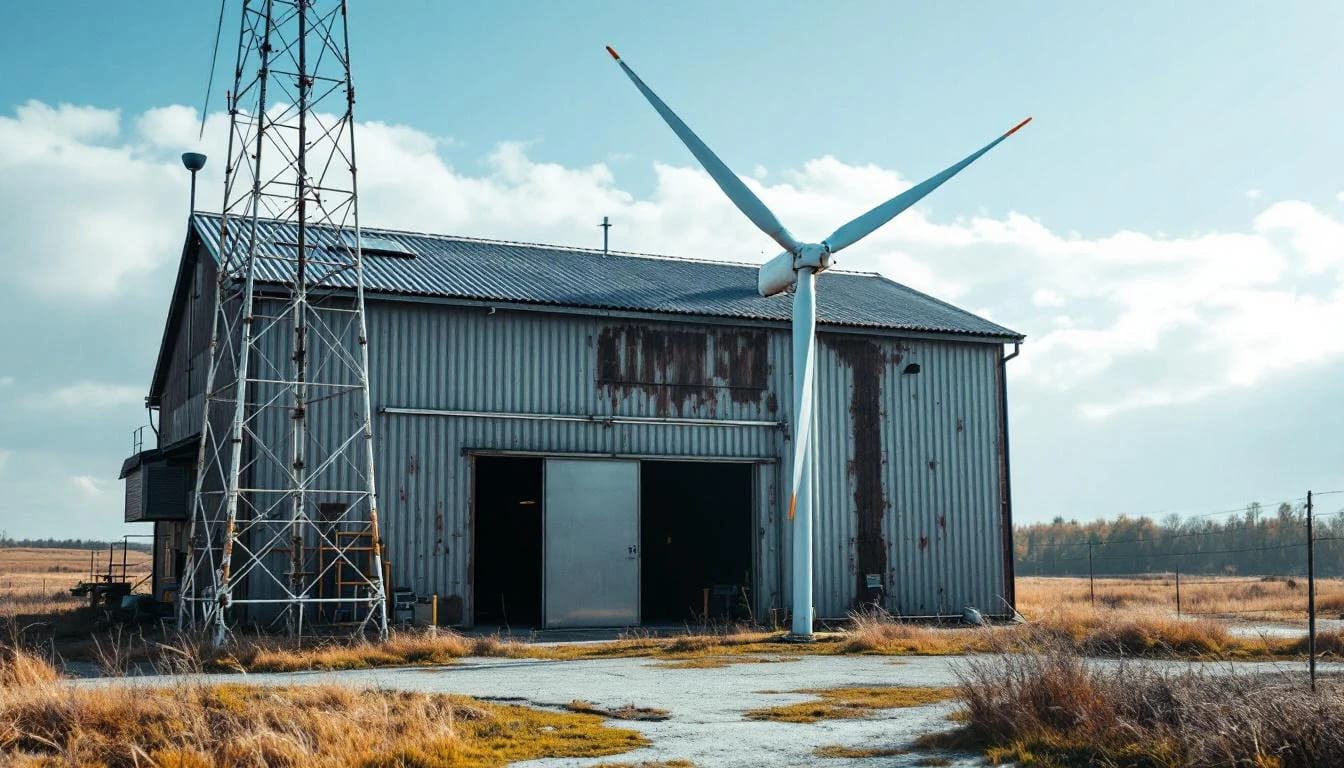
The Betz limit—also called the Betz coefficient—is the theoretical maximum efficiency for any wind turbine: 59.26%, commonly rounded to 59.3%. German physicist Albert Betz derived this figure in 1919 by applying conservation of momentum and energy to an ideal rotor. No matter the blade design, tower height, or generator technology, a turbine cannot extract more energy from the wind than the Betz limit permits. Real-world small wind turbines achieve 25–45% efficiency because of mechanical losses, generator inefficiencies, and sub-optimal wind conditions. Understanding the Betz limit helps homeowners and small-business operators set realistic expectations for energy capture and recognize marketing claims that promise impossibly high power coefficients.
What the Betz limit is and why it exists
Albert Betz published his analysis in Das Maximum der theoretisch möglichen Ausnutzung des Windes durch Windmotoren in 1919. He modeled wind passing through an ideal actuator disk—a frictionless, infinitely thin rotor with no wake turbulence. Betz proved that if a turbine extracted 100% of the wind's kinetic energy, the air downstream would stop moving entirely, creating a pressure wall that blocks upstream air from reaching the rotor. Conversely, extracting zero energy means the wind passes through undisturbed, delivering no power.
The optimum lies between these extremes. Betz calculated that a turbine extracts maximum power when the downstream wind speed drops to one third of the upstream speed. At that ratio, 59.26% of the kinetic energy converts to shaft power, and 40.74% remains in the moving air to allow continuous flow. The equation for wind power captured by an ideal rotor is:
P = ½ρAv³C_p
where ρ is air density (kg/m³), A is the swept area (m²), v is upstream wind speed (m/s), and C_p is the power coefficient (dimensionless, maximum 0.5926). Multiplying by the Betz limit shows that even an ideal turbine cannot exceed:
P_max = ½ρAv³ × 0.5926
This constraint applies to horizontal-axis turbines (HAWTs) like the Bergey Excel 10 and vertical-axis turbines (VAWTs) such as the Aeolos-V 3 kW equally. Blade count, material, and rotor diameter affect real efficiency, but none can surpass 59.3%.
![INLINE: Diagram showing wind flow through a turbine rotor with upstream velocity v₁, rotor plane velocity v, and downstream wake velocity v₂, illustrating momentum conservation]
How real small wind turbines compare to the Betz limit
Manufacturers list a turbine's power curve—kilowatts produced at given wind speeds—but rarely publish the power coefficient. Calculating C_p requires dividing measured electrical output by the theoretical wind power available in the swept area. For a 10-mph (4.47 m/s) wind passing through a 2.1-meter-diameter rotor (swept area 3.46 m²), the available power is:
P_available = ½ × 1.225 kg/m³ × 3.46 m² × (4.47 m/s)³ ≈ 188 watts
If the turbine delivers 75 watts at the inverter terminals, the system power coefficient is 75 ÷ 188 = 0.40, or 40%. That figure combines rotor aerodynamic efficiency, gearbox or direct-drive losses, generator efficiency, and controller conversion losses.
High-quality small HAWTs such as the Bergey Excel 10, Primus WindPower AIR X, and Southwest Windpower Skystream achieve rotor C_p values of 0.42–0.47 at optimal tip-speed ratio—the ratio of blade-tip velocity to wind speed. System C_p after electrical losses drops to 0.35–0.42. Vertical-axis models like the Pikasola 600W VAWT and Aeolos-V series typically reach 0.25–0.35 rotor C_p because of inherent drag on the returning blade and lower tip-speed ratios.
Three factors prevent reaching the Betz limit:
- Finite blade count—Betz assumed an infinite number of infinitely thin blades. Real rotors have two to five blades with measurable thickness, creating tip vortices and profile drag.
- Viscous losses—Air friction along blade surfaces dissipates energy as heat.
- Off-design operation—The Betz limit applies at one ideal tip-speed ratio. Below or above that speed, C_p falls. Small turbines in gusty, turbulent residential sites rarely operate at peak efficiency.
National Renewable Energy Laboratory (NREL) researchers validate manufacturer power curves through the Small Wind Certification Council testing protocol. NREL's distributed wind research group at the National Laboratory of the Rocker (previously NREL) publishes performance data showing measured C_p values and highlights discrepancies between rated and field output.
Why the Betz limit matters for site assessment and payback
A common homeowner mistake is multiplying average wind speed by a turbine's rated power and assuming year-round generation. The Betz limit—and sub-Betz real performance—means energy capture depends on wind-speed distribution, not just average speed. Wind power scales with the cube of velocity: doubling wind speed multiplies power by eight. A site averaging 10 mph but experiencing frequent 15-mph gusts delivers far more energy than a steady 10-mph site.
Energy professionals use the Weibull distribution to model wind variability. For a turbine with C_p = 0.40 at a site with 12-mph (5.36 m/s) average wind and a shape factor of 2.0, annual energy production (AEP) is:
AEP ≈ 8,760 hours × average power
where average power accounts for the cube-law weighting of speeds. A 2.5-meter-diameter turbine (swept area 4.91 m²) at that site produces roughly 2,200–2,600 kWh per year, assuming 35% overall system efficiency after inverter and battery losses. At $0.14 per kWh retail electricity price, annual savings reach $308–$364. With a $12,000 installed cost (typical for a 1.5–2 kW small HAWT including tower, inverter, and NEC Article 705 interconnection), simple payback exceeds thirty years—impractical without the 30% federal Residential Clean Energy Credit under IRC §25D, which reduces net cost to $8,400 and improves payback to approximately twenty-three years.
State incentives available through the DSIRE database can further lower upfront expense. Vermont's Small-Scale Renewable Energy Incentive Program, for example, offers additional cash grants. However, no financial incentive changes the physics: a turbine marketed at 2 kW will deliver 2 kW only at its rated wind speed (often 25–28 mph), and total energy capture remains bound by the Betz limit and real-world losses.
Blade design trade-offs and tip-speed ratio
The Betz limit applies at a specific tip-speed ratio (TSR), defined as:
TSR = (ω × R) / v
where ω is rotational speed (rad/s), R is rotor radius (m), and v is wind speed (m/s). High-efficiency three-blade HAWTs operate at TSR 6–8. At TSR = 7, blade tips move seven times faster than the wind. Lower-TSR turbines (TSR 2–4) use more blades or higher solidity, sacrificing peak C_p for better starting torque in light winds—a trade-off common in farm windmills and multi-blade designs.
Vertical-axis turbines inherently run at lower TSR (1.5–3.5) because the returning blade opposes rotation. Darrieus "eggbeater" VAWTs achieve higher C_p than Savonius drag-based designs but remain below HAWT efficiency. The Pikasola 600W three-blade Darrieus turbine, for instance, reaches C_p ≈ 0.30 at TSR 2.5, while a comparably sized Primus AIR 40 HAWT hits C_p ≈ 0.44 at TSR 7.
Blade pitch—fixed or variable—also affects efficiency. Small fixed-pitch turbines like the Bergey Excel 1 maintain constant blade angle, relying on aerodynamic stall to prevent over-speed in high winds. Larger distributed-wind turbines (10–100 kW) use active pitch control to hold C_p near maximum across a wider wind range, but the mechanism adds cost and complexity unsuitable for sub-5 kW residential units.
Common marketing myths and red flags
Manufacturers occasionally claim power coefficients exceeding 50% or "breakthrough efficiencies" above the Betz limit. These assertions violate fundamental physics and indicate either measurement error, misleading test conditions, or outright fraud. Red flags include:
- Rated power at unrealistic wind speeds—A 3 kW turbine rated at 8 mph wind cannot deliver 3 kW because the available wind power at that speed through a reasonable swept area is far less than 3 kW.
- Omitted swept-area data—Without rotor diameter, verifying claimed output against the Betz limit is impossible.
- "Augmented" or "concentrated" wind designs—Shrouds, diffusers, or funnels can increase local velocity at the rotor, but the Betz limit applies to the effective capture area including the shroud. Net system efficiency rarely improves because of added weight and complexity.
- Miraculous blade coatings or magnetic levitation—These may reduce friction slightly, pushing real C_p from 0.40 to 0.42, but they cannot overcome the 59.3% ceiling.
Independent testing by NREL or certification bodies like the Small Wind Certification Council provides verified power curves. The Interstate Turbine Advisory Council also publishes field reports comparing claimed versus measured performance. Before purchasing, cross-reference manufacturer data with third-party sources and calculate expected annual energy using conservative C_p values (0.25–0.35 for VAWTs, 0.35–0.42 for HAWTs).
Installation and code considerations for maximizing real-world efficiency
Even a well-designed turbine under-performs if installed incorrectly. NEC Article 705 governs interconnection of on-site generation, requiring labeled disconnects, proper grounding, and utility notification. A licensed electrician must handle the service-entrance integration. Turbulent wind caused by nearby buildings, trees, or terrain features reduces effective wind speed and increases fatigue loading, lowering operational C_p.
NREL recommends mounting small turbines at least 30 feet above obstructions within 300 feet. The WindWatts tool, developed by NREL and partner laboratories, provides high-resolution wind-resource maps and siting guidance for distributed wind projects. FAA Part 77 mandates notification for structures exceeding 200 feet above ground level; most residential turbines on 40–80 foot towers remain exempt but check local airport proximity.
Tower options include:
- Monopole—Single-tube tower, requires concrete foundation, minimal guy wires.
- Lattice—Steel framework, lighter and less expensive but larger footprint.
- Tilt-up—Hinged base for easy maintenance; guy-wire anchors must withstand full load.
Proper tower height directly impacts energy capture. Raising a turbine from 40 feet to 60 feet in suburban terrain can increase average wind speed by 1–2 mph, boosting annual energy by 25–40% because of the cube relationship. The added tower cost often pays for itself within the system's twenty-year life.
Hybrid systems pairing a small turbine with solar photovoltaics smooth seasonal variation—winter wind complements summer sun—and improve capacity factor. Battery storage (lithium iron phosphate recommended) allows time-shifting wind energy to evening peak-demand hours, maximizing financial return under time-of-use electricity rates.
Related concepts: tip losses, wake effects, and array optimization
Beyond the single-turbine Betz limit, additional losses occur in turbine arrays. Wake interference happens when an upstream turbine extracts energy, leaving slower, turbulent wind for downstream units. Commercial wind farms space turbines 3–5 rotor diameters apart crosswind and 7–10 diameters downwind to minimize wake impact. Residential sites rarely accommodate multiple turbines, but if two units share a property, separation should exceed 10 rotor diameters downwind.
Prandtl's tip-loss factor accounts for three-dimensional flow around blade tips where high-pressure air on the bottom surface leaks to low-pressure top surface, creating vortices. Winglets—vertical extensions at blade tips—reduce this loss by 2–4%, nudging real C_p slightly closer to the Betz limit. The Bergey Excel 10 and some Primus models incorporate winglets, though the benefit is modest on small rotors.
Computational fluid dynamics (CFD) software models these effects during design. NREL's OpenFAST and QBlade open-source tools simulate aeroelastic behavior, predicting C_p across TSR ranges and validating prototypes before field testing. Manufacturers using rigorous simulation and wind-tunnel testing produce more accurate power curves and achieve higher real-world efficiency.
Can a turbine ever exceed the Betz limit under any conditions?
No. The Betz limit is derived from first principles of mass and energy conservation. Controlled laboratory experiments and decades of field data confirm that no turbine—regardless of blade design, generator type, or augmentation—surpasses 59.3% rotor efficiency. Claims to the contrary indicate measurement error or misunderstanding of the swept-area definition.
Why do manufacturers rate turbines at high wind speeds if the Betz limit constrains output?
Rated power reflects the peak output at a specified wind speed, typically 25–30 mph. At that speed, the turbine reaches its design C_p and generator capacity. The Betz limit still applies—output at rated speed is a fraction of the theoretical maximum wind power in the swept area—but manufacturers choose a wind speed that produces a marketable power figure. Annual energy production depends on the site's wind distribution, not the rated power alone.
Do vertical-axis turbines have a different Betz limit?
The Betz limit is universal. VAWTs obey the same 59.3% ceiling. However, VAWTs typically achieve lower real-world C_p (0.25–0.35) than HAWTs (0.35–0.45) because of higher drag on returning blades and lower optimal tip-speed ratios. Both turbine types face identical thermodynamic constraints.
How does air density affect the Betz limit and turbine performance?
The Betz limit—59.3%—is a ratio and does not change with air density. However, absolute power output is directly proportional to density. At higher altitudes or in hot weather, air density drops, reducing power by roughly 3% per 1,000 feet of elevation or 1% per 10°F temperature rise. A turbine in Denver (5,280 feet) produces approximately 15% less power than the same turbine at sea level, all else equal.
What improvements could push real turbines closer to the Betz limit?
Advances in computational design, carbon-fiber blades, direct-drive permanent-magnet generators, and adaptive pitch control incrementally raise C_p. Modern utility-scale turbines reach C_p ≈ 0.50–0.52 at optimal conditions. Small turbines lag because of cost constraints—sophisticated controls and custom airfoils are economically viable only at megawatt scale. Future distributed-wind research at NREL focuses on lower-cost materials and modular designs to improve small-turbine efficiency affordably.
Bottom line
The Betz limit is not an engineering challenge to overcome but a physical reality defining maximum wind-turbine efficiency at 59.3%. Real small wind turbines for homes and farms operate at 25–45% efficiency because of aerodynamic losses, electrical conversion, and off-design conditions. Homeowners evaluating a turbine purchase should verify manufacturer power claims against independent test data, calculate annual energy using local wind distributions and conservative power coefficients, and consider the system cost after applying the 30% federal Residential Clean Energy Credit. Proper siting—preferably with NREL's WindWatts resource tool—and professional installation per NEC Article 705 maximize actual energy capture within the immovable boundary the Betz limit imposes. For detailed wind-resource data and distributed-wind project guidance, consult NREL's distributed wind research page.
Share this article
windturbinehome.com/s/cd2c6b
Editorial note: This article was researched and written by a member of the Wind Turbine Home editorial team. AI-assisted tools were used for spell-checking and light grammar review only — all research, analysis, and conclusions are our own. Our editorial policy prohibits sponsored content and paid placements. Read our editorial policy →
Related reading
small wind turbines
Furling vs Pitch Control on Small Wind Turbines: Rotor Protection Explained
Small wind turbines use furling or pitch control to protect rotors in high winds. Furling turns the turbine sideways; pitch feathers the blades. Compare costs, reliability, and best applications.
small wind turbines
Capacity Factor for Small Wind Turbines: Realistic Numbers by Site
Most residential wind turbines deliver 10–25% capacity factor in average sites, 25–35% in excellent wind. Learn what those numbers mean for your energy bills.

small wind turbines
Tip Speed Ratio for Residential Turbines: What to Spec
Tip speed ratio determines how efficiently your small wind turbine extracts energy. Learn optimal TSR ranges for HAWT vs VAWT, why it matters for residential installs, and how to match turbine specs to your site conditions.
small wind turbines
IEC 61400-2 Standard Explained: Small Wind Turbine Safety Guide
IEC 61400-2 sets the global safety and performance rules for wind turbines under 200 kW. This guide explains certification requirements, structural tests, and what compliance means for U.S. homeowners.
small wind turbines
What a 5 kW Turbine Produces in Different Wind Classes
A 5 kW small wind turbine generates 6,000-15,000 kWh/year depending on wind class. Class 3 sites (13-15 mph average) deliver 9,000-11,000 kWh annually—enough for most homes.
small wind turbines
Best Small Wind Turbines 1kW-10kW for Homes (2026 Guide)
Compare the top small wind turbines from 1kW to 10kW for residential properties. Real-world output, installed costs, and manufacturer specs—updated 2025.

small wind turbines
Permanent Magnet vs Induction Wind Generator: Which to Spec
Permanent magnet generators dominate residential wind turbines because they self-excite at low RPM and need no grid connection, while induction generators require grid tie and higher wind speeds.
small wind turbines
Best 3 kW Home Wind Turbines 2026: Cost and ROI Compared
Real prices, installation costs and payback for the Bergey Excel 1, Primus Air 40 and Aeolos-H 3kW, so US homeowners see which 3 kW turbine is worth it.
small wind turbines
5 kW Home Wind Turbine Systems: Brands, Output & Costs 2026
Five-kilowatt residential wind turbines cost $15,000–$40,000 installed. Compare Bergey Excel, Primus Air, and certified brands for output, tower height, and grid-tie options.