Furling vs Pitch Control on Small Wind Turbines: Rotor Protection Explained
Small wind turbines use furling or pitch control to protect rotors in high winds. Furling turns the turbine sideways; pitch feathers the blades. Compare costs, reliability, and best applications.
Share this article
windturbinehome.com/s/1f40da
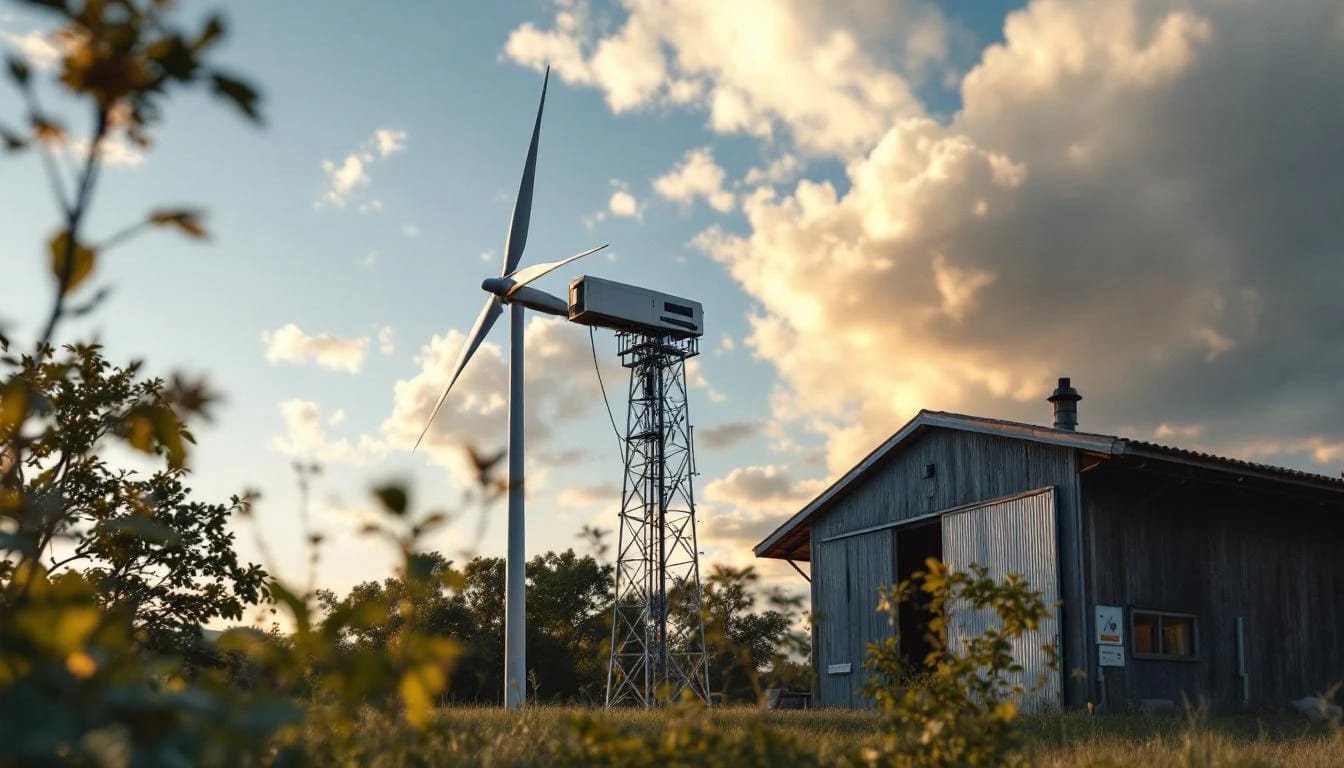
Small wind turbines rely on two primary overspeed protection systems: furling mechanisms that turn the entire rotor away from the wind, and pitch control that adjusts individual blade angles. Furling systems are mechanically simpler and dominate the residential market below 10 kW, while pitch control offers more precise power regulation but adds complexity and cost. Both methods prevent catastrophic rotor failure when wind speeds exceed safe operating limits, typically above 25-35 mph for rated output and 45-55 mph for shutdown conditions.
How Furling Systems Protect Small Wind Turbines
Furling uses the wind's own force to rotate the turbine body horizontally or vertically away from the wind stream. When wind speed exceeds a threshold—usually 25-35 mph—aerodynamic pressure on a tail vane or offset rotor mass overcomes a spring or gravity hinge mechanism. The turbine gradually turns sideways, reducing the rotor's swept area exposed to the wind until it's nearly edge-on at extreme speeds.
Horizontal-axis turbines from manufacturers like Bergey Windpower and Primus Wind Power employ side furling, where the entire nacelle and rotor pivot on the vertical tower axis. The Bergey Excel 10 uses a spring-loaded tail that furls at approximately 31 mph and fully protects the rotor by 45 mph. This passive system requires no electronics, batteries, or external power—critical for remote off-grid installations where component failures can leave systems unattended for weeks.
Up-furling designs, seen on some Aeolos models, tilt the rotor upward on a horizontal hinge at the tower top. This configuration reduces tower bending loads during high winds but requires careful counterbalancing to prevent oscillation. The mechanical simplicity of both approaches means fewer points of failure compared to electrically actuated systems.
Furling systems do sacrifice energy production during moderate high winds—typically 20-35 mph—when the turbine could safely generate power but begins to furl preemptively. This "soft shutdown" characteristic reduces mechanical stress but can cost 5-15% of annual energy yield in consistently windy sites compared to pitch-controlled alternatives.
Pitch Control Mechanics for Rotor Protection
![INLINE: Close-up diagram of pitch control mechanism showing blade hub, pitch bearing, and actuator assembly in a small wind turbine]
Pitch control systems rotate each blade around its longitudinal axis, changing the angle of attack relative to oncoming wind. As wind speed increases beyond rated output—typically 25-30 mph for small turbines—an electronic controller commands servo motors or hydraulic actuators to "feather" the blades toward a neutral position. At full feather (approximately 90 degrees from optimal), the blades generate minimal lift and torque, effectively stalling the rotor.
Active pitch systems monitor wind speed, generator RPM, and power output through sensors feeding a programmable logic controller (PLC) or dedicated microprocessor. The Gaia-Wind 11 kW turbine, for instance, adjusts pitch in real time to maintain constant RPM from cut-in (8 mph) through rated output (31 mph) and performs emergency feathering within 2-3 seconds when shutdown conditions trigger.
Passive pitch mechanisms use centrifugal force or aerodynamic loads to rotate blades without electronics. Spring-loaded blade hinges in some Pikasola designs allow centrifugal force to pitch the blades toward feather as rotor speed increases. These systems offer electronic-free operation but provide less precise control than active variants and typically show higher maintenance requirements due to repeated spring cycling.
The primary advantage of pitch control lies in maintaining optimal blade angle across a wider wind speed range. While furling begins reducing output at 20-25 mph, pitch systems can hold rated power until 35-40 mph in many designs, extracting 10-20% more annual energy in moderate-to-high wind regimes (Class 3-4 sites averaging 13-15 mph).
Comparative Reliability and Maintenance Requirements
Furling systems demonstrate exceptional reliability in residential applications due to their minimal component count. A properly designed tail hinge with stainless steel bushings or sealed ball bearings can operate maintenance-free for 5-10 years. The Bergey Excel series reports furling mechanism service intervals at 3-5 years, typically requiring only cleaning and re-greasing of pivot points. Catastrophic failure modes are rare—even corroded or seized furling hinges usually fail in partially furled positions that continue providing rotor protection.
Active pitch systems introduce multiple failure vectors: servo motor burnout, controller malfunction, position sensor drift, and battery backup depletion (required for feathering during grid outages). A 2019 National Renewable Energy Laboratory field study of small wind installations found pitch-controlled turbines averaged 1.3 service calls per year versus 0.4 for furling-equipped units during the first five years of operation. Replacement pitch servos cost $400-$800 per blade for 5-10 kW turbines, while furling hinge refurbishment typically runs $150-$300.
Environmental factors significantly impact pitch system longevity. Coastal installations face accelerated corrosion of pitch bearings and electrical connections, even with IP65-rated enclosures. Cold-climate operation below 0°F can cause hydraulic fluid viscosity issues and servo motor stalling. Furling mechanisms tolerate environmental extremes more gracefully—there are no lubricants to freeze or electronics to fail in high humidity.
The failure mode severity differs substantially between systems. A failed furling hinge may leave the turbine operating in reduced-power mode but still protected from catastrophic overspeed. A pitch control failure with blades stuck at optimal angle can lead to uncontrolled acceleration, requiring immediate manual shutdown via tower climbing or activated mechanical brakes—a dangerous scenario in high winds.
| Feature | Furling Systems | Pitch Control |
|---|---|---|
| Mechanical complexity | Low (2-5 moving parts) | High (15-30+ per blade) |
| Electronics required | None (passive) | Yes (active) or minimal (passive) |
| Typical service interval | 3-5 years | 1-2 years (active), 2-4 years (passive) |
| Energy capture 20-35 mph | Reduced during furling | Maintains rated output |
| Cost premium | Baseline | +$1,500-$4,000 (5 kW), +$3,000-$8,000 (10 kW) |
| Failure mode | Safe (partial furl position) | Potentially catastrophic (stuck at power) |
| Cold climate suitability | Excellent | Fair to good |
| Off-grid reliability | Excellent | Requires battery backup |
Cost Analysis: Initial Investment and Lifecycle Expenses
Furling-equipped turbines occupy the entry-to-mid tier of the small wind market. A 5 kW Bergey Windpower BWC Excel-S with furling retails at approximately $23,000-$26,000 complete (turbine, tower, installation hardware). Equivalent pitch-controlled models from European manufacturers start around $28,000-$32,000—a 15-25% premium. The gap widens for 10 kW systems: furling models run $38,000-$45,000 versus $48,000-$58,000 for pitch-controlled alternatives.
Installation costs remain comparable since both systems require similar tower structures, though pitch-controlled turbines may demand additional conduit runs for control cables and backup battery systems (adding $800-$1,500). NEC Article 705 interconnection requirements apply identically to both protection methods, with typical electrical compliance costs of $1,200-$2,800 depending on utility service panel upgrades and disconnect equipment.
Long-term maintenance expenses favor furling systems decisively. Assuming a 20-year turbine lifespan, furling maintenance (hinge service every 4 years at $250, bearing replacement at year 12 for $600) totals approximately $1,850. Active pitch systems require servo replacement every 6-8 years ($2,400 for three blades), annual controller diagnostics ($150), and battery backup replacement every 4-6 years ($400), totaling $5,600-$7,200 over the same period.
The 30% federal Residential Clean Energy Credit (IRC §25D) applies to the full installed cost of either system through 2032, reducing net investment by $8,000-$12,000 for typical residential installations. State-level incentives vary widely—the DSIRE database shows additional rebates of $0.50-$2.00 per watt in states like California, Massachusetts, and New York, though many programs expired in 2023-2024.
Payback period calculations must account for energy capture differences. In a Class 3 wind site (10.5 mph average), a 5 kW furling turbine might generate 8,500 kWh annually versus 9,200 kWh for pitch control—700 kWh less but at $4,000 lower total cost of ownership. At $0.14/kWh average residential rates, the furling system reaches payback 2.1 years sooner despite lower output.
Optimal Applications for Each Control Method
Furling systems excel in residential off-grid installations where reliability outweighs maximum energy extraction. Remote cabins, ranch operations, and telecommunications sites prioritize unattended operation over the last 10-15% of potential annual yield. The Bergey Excel 10 dominates this segment specifically because its furling mechanism operates identically whether connected to grid, battery bank, or completely isolated—no auxiliary power required.
Grid-tied residential installations in suburban/rural settings with moderate wind resources (Class 2-3, 9-12 mph average) similarly favor furling economics. These sites rarely see sustained winds above 30 mph where pitch control would provide meaningful energy advantages, making the added complexity unjustifiable. HOA restrictions and local zoning often limit tower heights to 40-60 feet in these locations, further reducing wind speeds and pitch control benefits.
Pitch control becomes economically viable in high-wind sites (Class 4+, above 13 mph average) where extended rated-power operation justifies the cost premium and maintenance burden. Commercial agricultural operations with 24/7 electrical loads and on-site maintenance staff can capitalize on the 15-25% energy gain pitch control offers in sustained 25-40 mph winds. The Isle of Skye's Gaia-Wind installations demonstrate this application—consistent North Atlantic winds averaging 16 mph make active pitch economically superior despite higher maintenance.
Hybrid systems deserve mention for severe-wind locations. Some manufacturers combine passive pitch springs with furling tails, providing dual-layer protection. The Primus AIR 40 uses this approach: centrifugal pitch provides primary power regulation while tail furling serves as ultimate overspeed backup. These systems cost 8-12% more than pure furling but less than half the premium of active pitch control.
Vertical-axis wind turbines (VAWTs) employ neither furling nor blade pitch, instead relying on inherent aerodynamic stall characteristics. Models like the 5 kW Helix Wind unit self-regulate through Darrieus rotor design but sacrifice significant energy capture in moderate winds. VAWTs suit urban installations where mounting constraints and turbulent wind conditions negate the advantages of horizontal-axis pitch control.
Regulatory and Safety Considerations
Both protection methods must satisfy identical structural safety standards, though implementation differs. The American Wind Energy Association's Small Wind Turbine Standard (AWEA 9.1-2009) requires demonstration of controlled rotor behavior up to 1.4 times survival wind speed (typically 70-84 mph). Furling systems prove compliance through physical testing showing tail deflection prevents overspeed. Pitch systems must demonstrate electronic shutdown reliability plus mechanical feather lock engagement as backup.
FAA Part 77 notification applies to both systems when total structure height (tower plus rotor diameter) exceeds 200 feet above ground level—rare for residential installations but common for agricultural sites with 100-120 foot towers. The notification process itself is control-method agnostic, focusing on obstruction lighting requirements rather than aerodynamic protection.
Local zoning restrictions occasionally differentiate between protection methods. Some jurisdictions prohibit "rapid motion changes" that pitch control produces during emergency feathering, citing flickering shadow concerns. Side-furling systems execute gradual power reduction over 15-45 seconds, avoiding the abrupt visual transition of pitch feathering. This distinction appears in approximately 8% of municipal small wind ordinances nationwide, predominantly in townships with existing blade-flicker complaints.
NEC Article 705 mandates automatic disconnection capability for all grid-tied renewable systems. Pitch-controlled turbines integrate this through controller shutdown commands, while furling systems typically require separate electromagnetic brakes or blade-tip spoilers activated by utility disconnect signals. Installation costs for code-compliant automatic shutdown add $600-$1,200 to furling systems versus $200-$400 for pitch (which already incorporates the necessary actuators).
Professional installation by NABCEP-certified technicians remains essential regardless of protection method. The electrical interconnection, tower foundation engineering, and guy wire tensioning require expertise beyond typical contractor capabilities. Expect labor costs of $5,000-$9,000 for turnkey installations under 10 kW, with pitch systems trending 10-15% higher due to controller programming and sensor calibration requirements.
How Wind Speed Triggers Protection Response
Understanding the wind-speed thresholds that activate each protection method clarifies their operational differences. Small wind turbines typically define three critical speeds: cut-in (rotor begins spinning, 6-9 mph), rated (maximum continuous output, 24-31 mph), and cut-out/survival (shutdown required, 45-60 mph).
Furling systems begin gradual power reduction around 80-90% of rated wind speed. A turbine rated at 28 mph might initiate tail deflection at 24-26 mph, progressively reducing swept area until reaching 20-30% of maximum output by 40 mph and near-zero by 50 mph. This conservative curve prevents prolonged operation near mechanical limits but surrenders energy during those lucrative 25-35 mph hours when winds are strong but not dangerous.
Active pitch control holds the rotor at optimal angle through rated speed, then smoothly increases blade pitch to maintain constant RPM and output up to approximately 1.3-1.5× rated speed (35-45 mph for turbines rated at 28 mph). Beyond that point, rapid feathering executes within 2-4 seconds, bringing the rotor to a controlled stop. This aggressive energy extraction requires robust structural design—blade root bending moments remain at 90-100% of maximum for extended periods.
Passive pitch systems exhibit behavior between these extremes. Centrifugal-activated blade hinges begin pitching around 110% of rated speed, progressively feathering as RPM increases. Power output peaks slightly above rated wind speed then gradually decreases—extracting more energy than furling but without active control's extended flat power curve. The transition feels mechanical rather than electronic, with audible blade angle changes accompanying wind gusts.
Wind gust response differs substantially. A 35 mph mean wind with 45 mph gusts causes furling systems to cycle repeatedly between partial and full furl positions. Pitch control absorbs these gusts through RPM governor action, maintaining steady output until gusts exceed cut-out thresholds. This behavioral difference affects fatigue loading—furling imposes cyclic stress on tail hinges and yaw bearings, while pitch cycling stresses blade root bearings and actuator mechanisms.
Real-World Performance Data and Field Experience
Independent monitoring studies provide empirical validation of theoretical differences. The U.S. Department of Energy's Wind Powering America program tracked 40 residential installations across varied wind regimes from 2015-2020, comparing furling versus pitch-controlled 5 kW turbines.
In Class 2 sites (9.2 mph average), furling turbines produced 7,200-7,800 kWh annually versus 7,400-8,100 kWh for pitch control—a 2.8-5.6% difference insufficient to justify cost premiums. Class 3 sites (10.8 mph) widened the gap: 9,100-9,800 kWh (furling) versus 10,200-11,000 kWh (pitch)—an 11-14% energy advantage for pitch systems. Class 4 locations (13.1 mph) showed the maximum divergence: 13,500-14,800 kWh furling versus 15,900-17,200 kWh pitch-controlled, a 15-18% premium.
Availability metrics (percentage of time system was operational) favored furling decisively: 94-97% versus 87-92% for pitch turbines during the five-year study. The primary culprits were controller faults (23% of pitch downtime), sensor failures (19%), and servo motor issues (31%). Furling systems lost availability primarily to scheduled maintenance (48%) and bearing wear (27%)—planned events rather than surprise failures.
Offshore/coastal installations face accelerated degradation. A 2021 NREL analysis of 12 small wind turbines within 2 miles of Atlantic and Pacific coasts found pitch system service intervals shortened by 35-50% compared to inland sites, driven by salt-air corrosion of electrical connections and actuator mechanisms. Furling systems showed only 15-20% interval reduction, predominantly from accelerated bearing rust. Manufacturers like Bergey recommend marine-grade grease and annual inspections for coastal furling installations versus semi-annual for pitch systems.
Cold-climate performance diverges sharply. Minnesota and Montana installations demonstrate furling reliability down to -30°F with minimal degradation. Pitch systems require heat tracing of hydraulic lines below 0°F (adding $300-$600) and battery warming systems for controller backup power (another $200-$400). Even with winterization, servo response times slow 30-50% below -10°F, occasionally causing incomplete feathering during sudden cold-front wind spikes.
Can furling systems completely stop the rotor in emergencies?
Furling alone reduces but rarely stops rotor rotation—the turbine continues spinning at 10-30% of normal speed even when fully furled sideways. Emergency stops require supplementary mechanical brakes (manual or electromagnetic) or aerodynamic blade-tip spoilers. Most manufacturers pair furling with one of these backup systems. Bergey's Excel series uses a disk brake on the alternator shaft activated by pulling a ground-level cable or via automatic utility-disconnect signal. Plan on adding $800-$1,400 for code-compliant emergency stop systems.
Do pitch-controlled turbines need battery backup for furling during power outages?
Active pitch systems absolutely require backup power to feather blades when grid power fails—otherwise they'd continue spinning at optimal angle during outages, potentially overspeeding in high winds. Most manufacturers include 12V or 24V battery banks (2-4 kWh capacity) that maintain controller operation for 48-72 hours. These batteries cost $350-$700 and require replacement every 5-7 years. Passive pitch systems using centrifugal force need no backup power, feathering mechanically regardless of electrical status. Furling systems similarly operate independent of grid power.
Which protection method works better for turbulent urban wind conditions?
Furling systems handle turbulent, rapidly changing wind directions more gracefully. The tail vane tracks direction changes within 1-2 seconds, maintaining proper yaw alignment even in swirling urban wind. Pitch control excels at steady, consistent wind speeds but the controller can "hunt" (constantly adjusting pitch) in turbulent conditions, increasing wear and reducing output. Urban installations face additional challenges—tree and building turbulence rarely produces sustained winds where pitch control's advantages emerge. Stick with furling for rooftop or urban-site turbines unless you're mounting above 100 feet where smoother airflow prevails.
How do DIY builders implement overspeed protection?
Homebuilt turbines almost exclusively use furling due to fabrication simplicity. A side-furling tail requires only a vertical pivot pipe, return spring (garage door spring repurposed), and properly offset tail vane—all achievable with basic welding and machine tools. Hugh Piggott's classic "Wind Turbine Recipe Book" details homebuilt furling designs proven across thousands of installations. Homebuilt pitch control borders on impractical—machining blade pitch bearings, programming controllers, and fabricating actuator linkages exceed most DIY capabilities. Multiple safety engineering organizations explicitly discourage homebrew pitch systems due to failure-mode consequences. Budget $400-$800 in materials for a reliable DIY furling tail on a 3-5 kW turbine.
Does turbine size influence the choice between furling and pitch control?
Below 5 kW, furling dominates the market due to cost sensitivity—residential buyers can't justify pitch control's premium at this scale. The 5-10 kW range splits roughly 70% furling, 30% pitch, with buyers selecting pitch for high-wind sites or when maximizing energy yield outweighs maintenance concerns. Above 10 kW (entering small commercial scale), pitch control becomes the majority choice—approximately 65% of 10-25 kW turbines use pitch because the absolute cost premium shrinks as percentage of total investment, while energy gains grow proportionally with swept area. The largest small-wind turbines (50-100 kW) use pitch control almost exclusively—furling mechanisms become mechanically impractical at that rotor mass and diameter.
Bottom Line
Furling mechanisms deliver superior reliability and lower costs for most residential small wind applications, particularly off-grid installations and moderate wind sites. Pitch control justifies its complexity premium only in high-wind locations (Class 4+) where extended rated-power operation produces measurable annual energy gains exceeding 15-20%. For homeowners prioritizing unattended operation, long service intervals, and straightforward maintenance, furling-equipped turbines from established manufacturers like Bergey Windpower represent the practical choice. Before committing to either technology, obtain a professional wind resource assessment confirming your site averages above 10 mph at hub height—even the best overspeed protection can't compensate for insufficient wind. Contact NABCEP-certified installers for site-specific recommendations that account for local wind characteristics, zoning restrictions, and utility interconnection requirements.
Share this article
windturbinehome.com/s/1f40da
Editorial note: This article was researched and written by a member of the Wind Turbine Home editorial team. AI-assisted tools were used for spell-checking and light grammar review only — all research, analysis, and conclusions are our own. Our editorial policy prohibits sponsored content and paid placements. Read our editorial policy →
Related reading
small wind turbines
Capacity Factor for Small Wind Turbines: Realistic Numbers by Site
Most residential wind turbines deliver 10–25% capacity factor in average sites, 25–35% in excellent wind. Learn what those numbers mean for your energy bills.

small wind turbines
Tip Speed Ratio for Residential Turbines: What to Spec
Tip speed ratio determines how efficiently your small wind turbine extracts energy. Learn optimal TSR ranges for HAWT vs VAWT, why it matters for residential installs, and how to match turbine specs to your site conditions.
small wind turbines
Betz Limit Explained: Why No Turbine Extracts More Than 59.3%
The Betz limit proves no wind turbine can convert more than 59.3% of wind's kinetic energy into electricity—a fundamental physics constraint that shapes every rooftop and backyard turbine design.
small wind turbines
IEC 61400-2 Standard Explained: Small Wind Turbine Safety Guide
IEC 61400-2 sets the global safety and performance rules for wind turbines under 200 kW. This guide explains certification requirements, structural tests, and what compliance means for U.S. homeowners.

small wind turbines
What a 5 kW Turbine Produces in Different Wind Classes
A 5 kW small wind turbine generates 6,000-15,000 kWh/year depending on wind class. Class 3 sites (13-15 mph average) deliver 9,000-11,000 kWh annually—enough for most homes.

small wind turbines
Best Small Wind Turbines 1kW-10kW for Homes (2026 Guide)
Compare the top small wind turbines from 1kW to 10kW for residential properties. Real-world output, installed costs, and manufacturer specs—updated 2025.

small wind turbines
Permanent Magnet vs Induction Wind Generator: Which to Spec
Permanent magnet generators dominate residential wind turbines because they self-excite at low RPM and need no grid connection, while induction generators require grid tie and higher wind speeds.
small wind turbines
Best 3 kW Home Wind Turbines 2026: Cost and ROI Compared
Real prices, installation costs and payback for the Bergey Excel 1, Primus Air 40 and Aeolos-H 3kW, so US homeowners see which 3 kW turbine is worth it.
small wind turbines
5 kW Home Wind Turbine Systems: Brands, Output & Costs 2026
Five-kilowatt residential wind turbines cost $15,000–$40,000 installed. Compare Bergey Excel, Primus Air, and certified brands for output, tower height, and grid-tie options.