Best Wind Turbines for Iowa Homes: Bergey vs Primus (2026)
Iowa averages 5.5-7.5 m/s wind at 30m, enough for a home turbine. Compare the Bergey Excel 10, Primus AIR 40 and VAWT options for grid-tied or off-grid use.
Share this article
windturbinehome.com/s/a28220
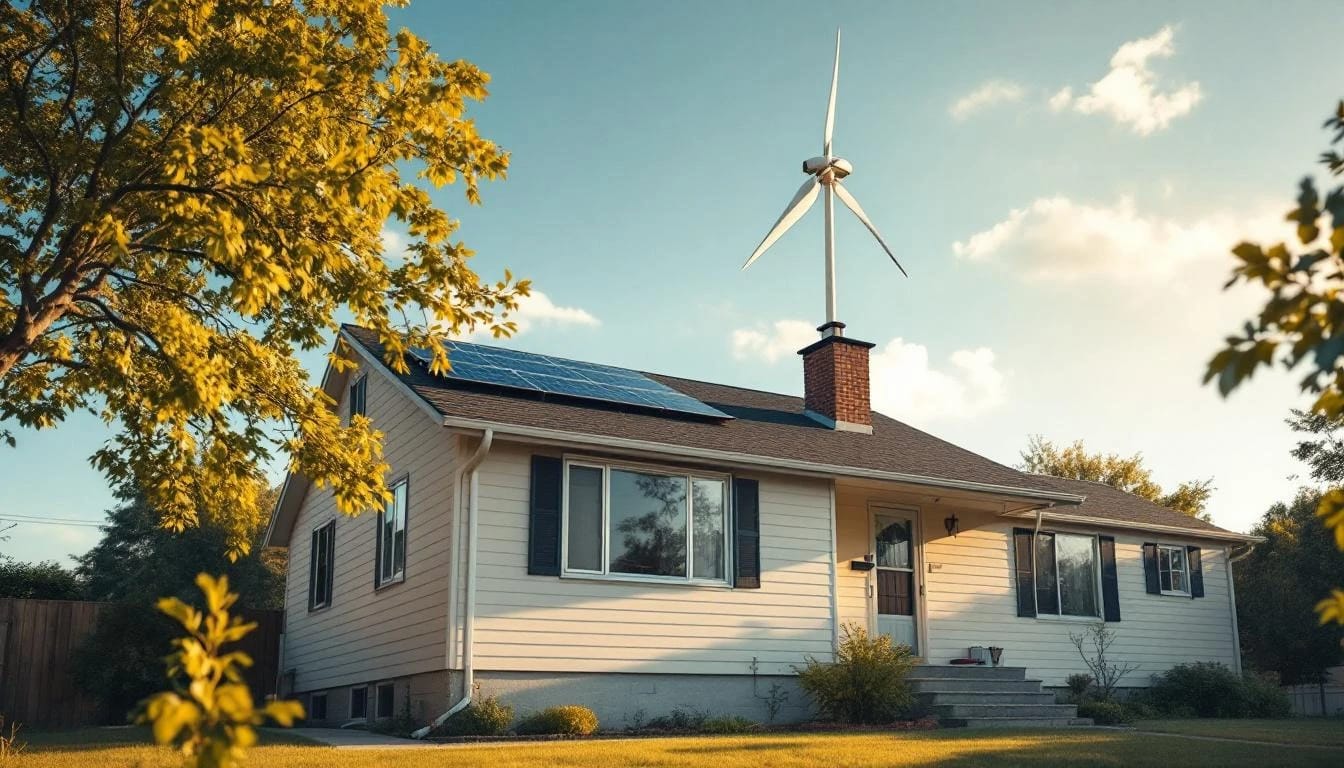
![HERO: Small horizontal-axis wind turbine installed on Iowa farmland with corn fields in background under blue sky]
Iowa ranks among the top five states for residential wind potential, with average annual wind speeds at 30 meters ranging from 5.5 to 7.5 meters per second across most counties—well above the 4 m/s threshold recommended by the Department of Energy for small wind power projects. The state's flat terrain, minimal tree cover, and consistent westerly winds create ideal conditions for home turbine installations, particularly in rural areas where setback requirements and noise ordinances pose fewer barriers.
Why Iowa excels for residential wind power
The Department of Energy's WINDExchange maps show that Iowa's wind resources at residential turbine heights (15-40 meters) outperform most of the Midwest. Counties in northwest Iowa—including Sioux, O'Brien, Lyon, and Osceola—register 30-meter wind speeds of 7.0-7.5 m/s, while central and southern counties still maintain 5.5-6.5 m/s averages. These speeds translate to capacity factors of 18-28% for properly sized turbines, meaning a 10 kW turbine in a strong Iowa location can generate 15,000-24,000 kWh annually.
Iowa imposes no state sales tax on wind energy equipment and offers property tax exemptions for renewable energy installations through Iowa Code §427B.26. The federal 30% Residential Clean Energy Credit (IRC §25D, claimed via IRS Form 5695) remains available through 2032, covering turbine costs, towers, inverters, and professional installation. A $40,000 turnkey system becomes $28,000 after the federal credit, with the Iowa exemption saving another $800-1,200 in annual property taxes on a typical rural parcel.
Local utilities operate net metering programs under Iowa Code §476.6(19), though terms vary. MidAmerican Energy credits excess generation at the retail rate for the first year, then at wholesale avoided-cost rates (typically 2.5-4.5¢/kWh) thereafter. Alliant Energy offers month-to-month netting with annual true-ups. Before signing interconnection paperwork, confirm whether the utility applies standby charges or demand fees to wind systems—some Iowa cooperatives assess $15-30/month facilities charges that erode small-system economics.
![INLINE: DOE WINDExchange map of Iowa showing 30-meter wind speed zones color-coded from yellow (5.5 m/s) to dark orange (7.5 m/s)]
Top horizontal-axis turbines for Iowa installations
Bergey Excel 10 (10 kW)
The Bergey Excel 10 dominates the Iowa residential market for grid-tied systems. Its 7-meter rotor diameter, permanent-magnet alternator, and autofurling design handle Iowa's variable wind conditions without complex electronics. Cut-in wind speed is 2.5 m/s; rated power arrives at 13.4 m/s. A 24-meter tilt-up tower installation costs $55,000-68,000 installed, depending on site preparation and electrical runs.
Annual output in a 6.5 m/s site: 18,000-22,000 kWh. The Excel 10 carries the Small Wind Certification Council (SWCC) label and meets NEC Article 705 interconnection requirements. Bergey's 5-year warranty covers the turbine; tower warranties are separate. The company has operated since 1977, and parts availability for legacy models remains strong—critical for a 20-30 year investment.
Primus AIR 40 (2.5 kW)
The Primus AIR 40 suits smaller loads: cabins, workshops, or homes aiming to offset 30-40% of usage rather than achieve full independence. Its 2.1-meter rotor and direct-drive generator start producing at 2.5 m/s and reach 2.5 kW at 12.5 m/s. Marine-grade construction resists Iowa's freeze-thaw cycles and summer humidity.
Installed cost on a 12-meter monopole: $14,000-18,000. Annual output in a 6 m/s site: 3,200-4,000 kWh. The AIR 40's compact footprint and relatively quiet operation (36 dBA at 10 meters) make it viable for acreage parcels in semi-rural subdivisions where larger turbines trigger neighbor complaints. Primus Wind turbines lack SWCC certification but hold CE marks and have been deployed in North America since the 1990s under the Air-X and Air Breeze brands.
Endurance E-3120 (50 kW)
For Iowa farms with high consumption—grain drying, livestock facilities, irrigation pumps—the Endurance E-3120 bridges residential and small commercial classes. The 15-meter rotor produces 50 kW at 11 m/s. Cut-in speed: 2.5 m/s. Installation on a 37-meter tower runs $180,000-240,000, and the system qualifies for both the 30% residential credit (if installed at the owner's primary residence property) and Section 179 depreciation if classified as farm equipment.
Annual output in a 7 m/s site: 90,000-120,000 kWh. Endurance turbines use a direct-drive permanent-magnet generator and electronic blade pitch control. The 50 kW size requires a transformer and dedicated utility interconnection study ($1,500-4,000) under NEC Article 705. Most rural Iowa cooperatives approve E-3120 installations within 3-6 months if site analysis confirms fault current and voltage regulation compliance.
Vertical-axis turbines: niche applications for Iowa
Vertical-axis wind turbines (VAWTs) promise omnidirectional wind capture and lower tip speeds, but their real-world performance in Iowa's steady horizontal winds lags behind HAWTs. The Aeolos-V 3 kW (3-meter height, 1.5-meter rotor diameter) cuts in at 2 m/s and reaches rated power at 10 m/s. Installed cost: $12,000-16,000 on a ground-mounted frame.
Annual output in a 6 m/s site: 2,000-2,800 kWh—roughly 30% less than a comparably rated HAWT due to lower swept area and higher drag. VAWTs suit urban Iowa properties (Des Moines, Cedar Rapids, Iowa City) where zoning restricts tower heights to 10-15 meters and aesthetic concerns favor non-rotating silhouettes. They also work for barn roof installations where wind direction swirls unpredictably.
The Pikasola 600W VAWT retails for $1,200-1,800 and pairs with a 12V or 24V battery bank for off-grid sheds or RV charging. Expect 400-600 kWh/year in a 5.5 m/s site—adequate for LED lighting, a 12V water pump, and DC refrigeration in a hunting cabin. Pikasola's Darrieus-Savonius hybrid rotor tolerates turbulent wind better than pure Darrieus designs, but the absence of third-party testing data makes performance claims speculative.
| Turbine Model | Rated Power | Rotor Diameter | Cut-In Speed | Typical Iowa Output | Installed Cost | SWCC Certified |
|---|---|---|---|---|---|---|
| Bergey Excel 10 | 10 kW | 7 m | 2.5 m/s | 18,000-22,000 kWh/yr | $55,000-68,000 | Yes |
| Primus AIR 40 | 2.5 kW | 2.1 m | 2.5 m/s | 3,200-4,000 kWh/yr | $14,000-18,000 | No |
| Endurance E-3120 | 50 kW | 15 m | 2.5 m/s | 90,000-120,000 kWh/yr | $180,000-240,000 | No (commercial class) |
| Aeolos-V 3kW | 3 kW | 1.5 m (H×W) | 2 m/s | 2,000-2,800 kWh/yr | $12,000-16,000 | No |
| Pikasola 600W | 600 W | 1.2 m (H×W) | 2 m/s | 400-600 kWh/yr | $1,200-1,800 | No |
Zoning, permits, and the FAA in Iowa
Iowa counties and municipalities enforce wildly inconsistent wind turbine ordinances. Unincorporated areas in rural counties often permit turbines by right if setbacks exceed 1.1-1.5× tower height from property lines and occupied structures. Incorporated towns frequently cap tower heights at 35-50 feet, rendering utility-scale HAWTs impractical and forcing residents toward shorter towers with reduced output.
Story County's ordinance requires 750-foot setbacks from non-participating residences for towers over 100 feet, effectively banning large turbines in developed areas. Johnson County's regulations distinguish between "accessory" turbines (under 100 feet, permitted after site plan review) and "principal use" turbines (over 100 feet, conditional use permit required). Polk County has no countywide wind ordinance, leaving regulation to individual cities—West Des Moines prohibits towers above 45 feet in residential zones, while unincorporated Polk County has no height restrictions beyond FAA rules.
FAA Part 77 triggers a filing requirement for any structure exceeding 200 feet above ground level, or any structure within 20,000 feet of a public-use airport that penetrates imaginary surfaces defined by runway approach angles. Most residential turbines (15-40 meter towers = 49-131 feet) avoid Part 77 filings unless near airports. The FAA's online Notice Criteria Tool (oeaaa.faa.gov/oeaaa) provides instant determinations. Filing itself is free and typically takes 40-60 days.
All Iowa wind installations must comply with NEC Article 705 (Interconnected Electric Power Production Sources). This mandates a dedicated disconnect, anti-islanding protection, and ground-fault detection. A licensed Iowa electrician must perform the work and pull permits through the local building department. Interconnection agreements require utility approval before energizing the system—expect a $250-800 application fee and a 4-12 week review.
Selecting the right turbine for your Iowa property
Start with a full year of energy bills. Calculate monthly and annual kWh consumption. A turbine sized to meet 80-120% of annual usage balances economics and resilience. Oversizing by 150-200% works only if the utility offers fair net metering and you plan to add electric vehicle charging or electric heat.
Measure or model your site's wind resource. DOE's WINDExchange 30-meter maps offer regional averages, but local topography matters. A ridge-top site 50 feet higher than surrounding terrain gains 0.5-1.0 m/s in average wind speed—enough to boost annual output by 30-50%. Valleys, dense tree lines, and downwind buildings create turbulence that reduces turbine life and efficiency.
Professional site assessments range from $500 (desktop analysis using GIS terrain models and regional wind data) to $3,000 (12-month anemometer data logger at hub height). Small wind site assessment services provide calibrated estimates. For DIY evaluation, the National Renewable Energy Laboratory's System Advisor Model (SAM) software runs free simulations using WINDExchange data inputs.
Tower height drives output. A 30-meter tower in a 6 m/s site yields 20-30% more kWh than a 20-meter tower. But every added meter costs $150-300 in materials and labor. The optimal height for most Iowa sites is 24-30 meters for 5-10 kW turbines and 30-37 meters for 10-50 kW systems—tall enough to clear surface turbulence, low enough to avoid Part 77 filings and extreme zoning restrictions.
Tilt-up towers simplify maintenance. Bergey, Primus, and most residential manufacturers offer crank-up or gin-pole tilt designs that let a two-person crew lower the turbine for blade inspections or generator service. Fixed towers require a crane ($1,500-3,000 mobilization) or climbing gear for every service call. Budget for routine maintenance every 2-3 years: checking bolts, greasing bearings, testing electrical connections.
Battery backup vs. grid-tied configurations
Grid-tied systems without batteries cost 40-50% less than off-grid systems and avoid the complexity of charge controllers, battery banks, and inverter programming. Iowa's net metering laws and reliable rural electric cooperatives make grid-tied the default choice for most homeowners. The turbine's AC output feeds directly into the main panel via a bi-directional meter; no storage needed.
Off-grid systems require a battery bank sized for 2-5 days of autonomy. A 10 kWh/day household needs 20-50 kWh of usable storage—$8,000-18,000 in lithium iron phosphate batteries at 2025 prices. Flooded lead-acid batteries cut upfront costs in half but require monthly maintenance and replacement every 5-7 years. The charge controller and inverter add $3,000-6,000.
Hybrid systems pair grid connection with backup storage. During normal operation the turbine exports excess power under net metering. When the grid fails, an automatic transfer switch isolates the home and the battery bank supplies critical loads. Tesla Powerwall and Enphase IQ Battery systems integrate with wind turbines via AC coupling. Installed cost for 13.5 kWh of backup storage: $12,000-16,000.
Battery storage for residential wind systems explains sizing, chemistry trade-offs, and controller selection in detail. Iowa's average grid reliability (1.2 outage events per year, 140 minutes total downtime) makes backup batteries a luxury rather than a necessity for most properties.
Real-world costs and payback in Iowa
A typical 10 kW Bergey Excel 10 turnkey installation in northwest Iowa:
- Turbine and controller: $34,000
- 24-meter tilt-up tower: $12,000
- Foundation and site prep: $3,500
- Electrical (disconnect, wire, interconnection): $4,500
- Permits and utility application: $1,000
- Professional installation labor: $10,000
- Total: $65,000
- Federal 30% tax credit: -$19,500
- Net cost: $45,500
Annual output at 6.8 m/s average: 20,000 kWh. Offset value at $0.13/kWh retail rate: $2,600/year. Simple payback: 17.5 years. With Iowa's property tax exemption saving $950/year (assumes $65,000 assessed value, $1.46% effective rural rate), adjusted payback drops to 12.8 years.
Smaller 2.5 kW systems (Primus AIR 40) show faster payback but lower absolute savings:
- Equipment and installation: $16,000
- Federal 30% credit: -$4,800
- Net cost: $11,200
- Annual output: 3,500 kWh
- Annual savings: $455/year
- Simple payback: 24.6 years
The math improves if the household otherwise pays $0.16-0.20/kWh (common for Iowa's smaller municipal utilities) or if DIY tower installation reduces upfront costs by $5,000-8,000.
Maintenance, warranties, and longevity
Horizontal-axis turbines need bearing grease, bolt re-torquing, and electrical inspections every 2-3 years. Budget $400-700 per service call if hiring a technician. Tilt-up towers make this a half-day DIY task for mechanically inclined owners. Brushes in older DC turbines wear out every 5-10 years ($150-400 in parts); permanent-magnet alternators eliminate this expense.
Bergey warranties the Excel 10 for 5 years on the turbine, 2 years on the controller. Tower warranties are 1-2 years. Extended warranties cost 8-12% of turbine price and rarely prove worthwhile—most failures occur during commissioning (covered by installation warranty) or after 10+ years (outside extended terms anyway).
Expected service life for quality residential turbines: 20-25 years. The generator may need rewinding or replacement at 15-20 years ($3,000-6,000 for 10 kW units). Towers and foundations last 30-40 years if galvanizing remains intact and bolts are retorqued on schedule. Annual inspection checklists and lubrication schedules appear in manufacturer manuals—follow them religiously to avoid premature failures.
Vertical-axis turbines experience higher mechanical stress because the entire rotor operates in constant tension/compression cycles. Bearings and shaft couplings wear faster than HAWTs. Aeolos-V models include a 2-year warranty; Pikasola offers 1 year. Real-world VAWT lifespans in Iowa: 10-15 years for mid-grade models, 5-8 years for budget imports.
How much wind do I need to make a home turbine worthwhile in Iowa?
The Department of Energy recommends annual average wind speeds of 4 m/s or greater at 30 meters for small wind projects. Most of Iowa exceeds 5.5 m/s, making residential turbines economically viable. Sites above 6.5 m/s achieve payback periods under 15 years with the federal tax credit. Order a professional site assessment if your property is heavily wooded, in a valley, or surrounded by two-story buildings.
Do Iowa property taxes increase when I install a wind turbine?
No. Iowa Code §427B.26 exempts renewable energy installations from property tax assessment. The turbine, tower, and related equipment add zero dollars to your taxable value. Your county assessor may request documentation (purchase receipts, interconnection approval) during the next revaluation cycle, but the exemption applies automatically without annual filings.
Can I install a wind turbine myself to save money in Iowa?
You can legally erect the tower and mount the turbine without a contractor license if the work occurs on your own property. However, NEC Article 705 requires a licensed electrician to perform all interconnection wiring, install the required disconnect and safety devices, and obtain electrical permits. DIY tower installation can save $6,000-10,000 but demands rigging skills, concrete work, and 3-4 helpers. Mistakes risk turbine damage, injury, or outright collapse. DIY wind turbine installation guide covers tools, safety, and legal boundaries.
Will my utility buy excess power from my wind turbine at retail price?
Iowa's net metering law (Iowa Code §476.6(19)) requires investor-owned utilities to credit excess generation, but rate structures vary. MidAmerican Energy credits at retail rate for the first year, then switches to avoided-cost wholesale rates (2.5-4.5¢/kWh)—well below the 12-15¢/kWh retail rate. Municipal utilities and cooperatives set their own terms; some offer indefinite retail-rate netting, others pay wholesale from day one. Read the interconnection agreement carefully and model economics using the utility's actual rate schedule.
How tall of a tower can I build without FAA approval in Iowa?
FAA Part 77 requires notification for structures exceeding 200 feet above ground level, or structures near airports that penetrate defined imaginary surfaces. Most residential turbine towers (15-40 meters = 49-131 feet) avoid FAA filings. Use the FAA's Notice Criteria Tool at oeaaa.faa.gov to check your specific site coordinates. Even if FAA filing is unnecessary, local zoning may cap heights at 35-100 feet depending on county and municipality. Always confirm zoning limits before purchasing equipment.
Bottom line
Iowa's wind resource, tax exemptions, and net metering policies create one of the nation's strongest cases for residential wind power. Bergey Excel 10 systems deliver the best balance of output, reliability, and parts support for grid-tied homes; Primus AIR 40 turbines suit smaller loads and tighter budgets. Vertical-axis models remain niche solutions for urban parcels or roof mounts. Confirm local zoning, secure utility interconnection approval, and hire a licensed electrician for NEC-compliant wiring—then let Iowa's westerlies start reducing those monthly bills.
Request a professional wind site assessment or review Iowa wind turbine incentives to calculate your property's specific payback period.
Share this article
windturbinehome.com/s/a28220
Editorial note: This article was researched and written by a member of the Wind Turbine Home editorial team. AI-assisted tools were used for spell-checking and light grammar review only — all research, analysis, and conclusions are our own. Our editorial policy prohibits sponsored content and paid placements. Read our editorial policy →
Related reading
residential wind power
Home Wind Turbine: A Comprehensive US Buyer's Guide 2024
Explore the realities of owning a home wind turbine in the US, covering costs, energy output, installation requirements, and available federal and state incentives for homeowners considering small-scale wind power.
residential wind power
Home Wind Turbine Systems: A Complete 2024 Buyer's Guide
Explore the realities of a home wind turbine system for residential power, covering installation, costs, grid-tie considerations, and US federal incentives.
residential wind power
First-Year Mistakes New Home Wind Turbine Owners Regret Most
New home wind turbine owners make costly first-year errors—from poor site assessment to skipping permits. Learn the eleven most common mistakes and how to avoid them.
residential wind power
Grid-Tied vs Battery-Backed Wind Turbine Systems for Homes
Grid-tied systems feed excess wind power directly to the utility for credits, while battery-backed configurations store energy for outages and off-grid use.
residential wind power
How to Right-Size a Wind Turbine for Your House in 2026
Match your home wind turbine to your actual energy use and site conditions. Learn the sizing formula, power curves, and common mistakes to avoid before you buy.
residential wind power
Best Wind Turbines for Australian Homes: STCs & 2026 Picks
Small wind turbines can earn STCs under the SRES, but few models sold in Australia meet AS 4509.1. Compare Bergey, Primus and proven vertical-axis picks.
residential wind power
Best Wind Turbines Under $5000 for Home Use (2026 Guide)
Compare the top small wind turbines under $5000 for residential use in 2026. Real performance data, installation costs, and ROI analysis for US homeowners.
residential wind power
Best Wind Turbines for Texas Homes: 1-10 kW Picks (2026)
Compare 1-10 kW small wind turbines for Texas homes, including which models suit your local wind zone, what they cost, and which incentives you can claim.
residential wind power
Wind Turbine for Power Outage Backup: Realistic Resilience Design
Small wind turbines can provide backup power during outages, but the system requires battery storage, proper NEC-compliant installation, and realistic expectations about spinning up from zero wind.