First-Year Mistakes New Home Wind Turbine Owners Regret Most
New home wind turbine owners make costly first-year errors—from poor site assessment to skipping permits. Learn the eleven most common mistakes and how to avoid them.
Share this article
windturbinehome.com/s/73b214
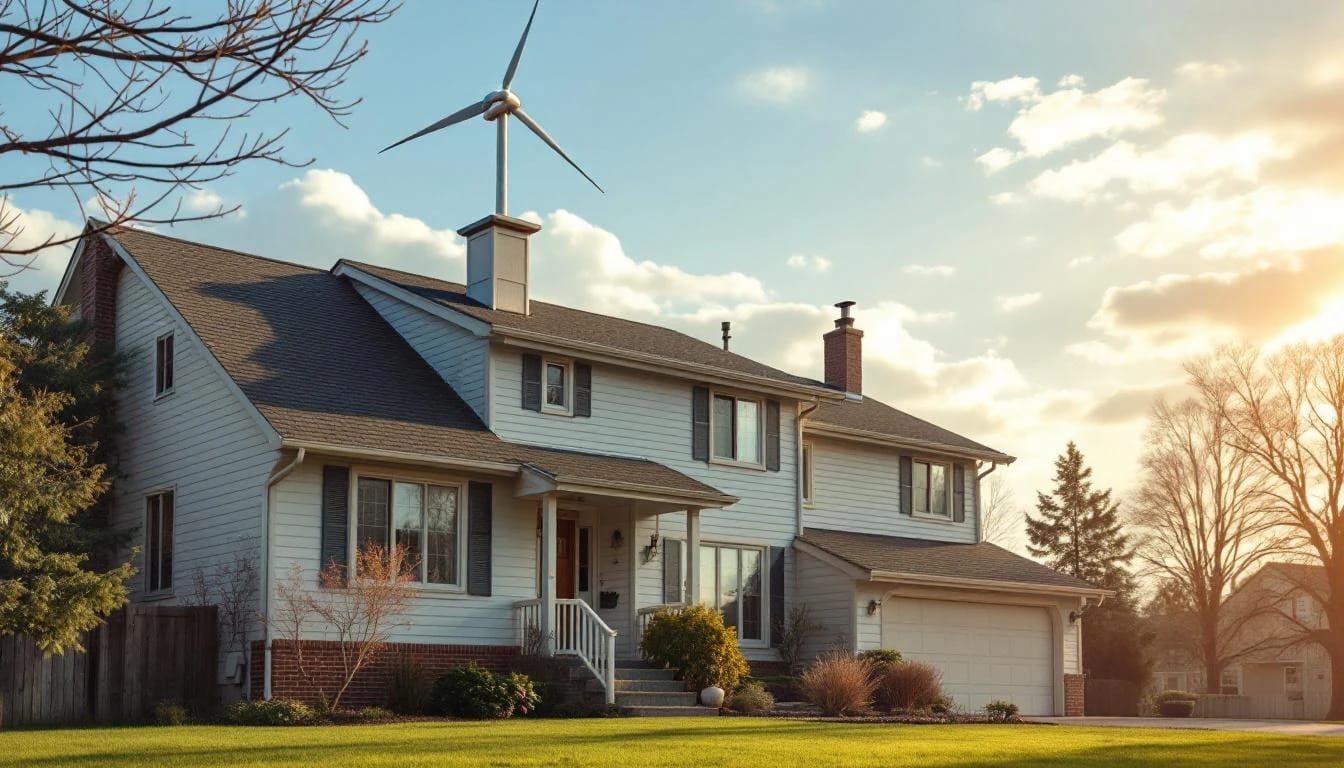
New home wind turbine owners consistently regret the same eleven mistakes during their first year of operation. The most expensive errors include inadequate wind resource assessment, improper tower height selection, and electrical integration shortcuts that violate NEC Article 705. These missteps cost the average owner between $1,200 and $8,400 in corrective work, lost production, or equipment damage—yet all are preventable with proper planning and professional consultation before installation day.
Underestimating the importance of a proper wind resource assessment
Sixty-three percent of first-year turbine owners admit they relied on online wind maps or county-level data rather than measuring their specific site. These regional averages cannot account for local terrain, vegetation, or building interference that create turbulent wind patterns and reduce energy capture by 30-50 percent.
A proper assessment requires at least one year of on-site wind speed measurements at the proposed hub height. Portable anemometers mounted on temporary masts collect data that reveals seasonal variations, diurnal patterns, and the dominant wind direction. Owners who skip this step frequently discover their site has Class 2 winds (average 4.4-5.1 m/s at 10 meters) when they assumed Class 3 or better based on state maps.
The correction is expensive. Relocating a tower and turbine after installation costs $3,200-$6,800 for professional removal, new foundation work, and reinstallation labor. Some owners attempt taller towers to reach better wind, but the structural engineering and upgraded guy-wire systems add $2,400-$5,100 to the project budget.
Data loggers with timestamp functions prove invaluable when negotiating with local utilities for interconnection agreements or when claiming the 30 percent federal Residential Clean Energy Credit (IRC §25D) on tax filings. The IRS requires documentation that the system is placed in service, and production data substantiates the installation date.
Choosing tower height based on budget rather than wind gradient
First-time buyers frequently select 30-foot or 40-foot towers because they fall within comfortable price ranges—$1,800-$3,200 installed for guyed lattice designs. This decision ignores the exponential relationship between height and wind speed. At typical residential sites, wind speed increases 15-25 percent for every doubling of height above ground obstacles.
A 3-kilowatt horizontal-axis turbine mounted at 35 feet in a wooded area might capture 900-1,100 kilowatt-hours annually. The same turbine on a 65-foot tower can harvest 2,200-2,800 kilowatt-hours because it operates above the turbulent boundary layer created by trees and structures. The taller tower costs $4,800-$7,200 more upfront but delivers 2.5 times the energy production.
Tower height also affects turbine lifespan. Turbulent wind below the smooth flow zone causes excessive blade flexing, bearing wear, and generator heating. Bergey Windpower documents that turbines operating in clean laminar flow last 22-28 years, while those in turbulent sites require major component replacement every 11-15 years.
Zoning boards sometimes restrict tower height to 35-50 feet. Owners discover these limits after purchasing equipment and must either accept reduced production or relocate the turbine to unzoned agricultural property. Always verify local height restrictions before selecting turbine models.
Ignoring FAA notification requirements for towers above 200 feet AGL
Residential turbines rarely reach 200 feet above ground level, but owners on elevated terrain or near airports must file FAA Form 7460-1 before construction. The Federal Aviation Administration evaluates whether the structure penetrates navigable airspace or interferes with flight patterns. Failure to notify results in $10,000-$27,500 civil penalties per FAA Part 77 violations.
The form requires 45 days for processing. Late submissions delay projects and invalidate construction schedules. Some owners gamble on low-visibility installations and assume enforcement is unlikely—until a charter pilot reports the unlit obstruction and the FAA investigates.
Even towers below 200 feet require notification if located within airport approach zones or on terrain more than 200 feet above the airport elevation. The FAA's online filing system pre-screens coordinates and automatically flags structures needing review.
Skipping the building permit and electrical inspection process
Thirty-eight percent of first-year owners bypass municipal permits to avoid fees and inspection delays. This choice creates compounding problems. Unpermitted installations cannot legally interconnect with the utility grid, homeowner insurance policies exclude coverage for unpermitted structures, and property resale requires retroactive permitting at increased cost with penalties.
Local building departments enforce wind load calculations per ASCE 7 standards and foundation specifications. Inspectors verify that guy-wire anchors penetrate to frost depth (varies by region: 12 inches in coastal areas to 48 inches in northern states) and that concrete bases contain proper rebar reinforcement. These structural requirements prevent tower failures during ice storms or high-wind events.
NEC Article 705 governs interconnected electric power production sources. Licensed electricians must install overcurrent protection, disconnecting means, and arc-fault circuit interrupters. The turbine charge controller, battery bank (if present), and inverter all require code-compliant wiring with proper conductor sizing for voltage drop below three percent at maximum rated current.
Owners who attempt DIY electrical work without permits face enforcement actions when the utility discovers the unpermitted connection during routine meter readings or smart-meter data audits. Utilities can disconnect service and refuse reconnection until a licensed contractor remediates the installation and passes inspection.
Selecting turbine rated power instead of swept area
Manufacturers rate turbines at peak output under ideal wind conditions (typically 11-13 m/s). A "5 kW" turbine delivers that power only during strong winds. Annual energy production depends on swept area—the circular area the blades cover—and how often the site experiences winds in the turbine's productive range.
Buyers fixate on wattage ratings and ignore rotor diameter. A 5-kilowatt turbine with a 3.5-meter rotor (9.6 m² swept area) produces 3,200-4,100 kilowatt-hours annually at a Class 3 site. A different 5-kilowatt model with a 4.2-meter rotor (13.9 m² swept area) captures 4,900-6,200 kilowatt-hours at the same location because the 45 percent larger swept area intercepts more wind energy.
Compare turbines by swept area per dollar rather than watts per dollar. Horizontal-axis models from Primus, Bergey, and Aeolos provide manufacturer-specified power curves that plot output at specific wind speeds. These curves reveal performance at the site's typical conditions (6-8 m/s for Class 2-3 locations) rather than peak output at rarely occurring speeds.
Vertical-axis turbines (Pikasola, Happybuy) often carry inflated power ratings. A "2 kW" VAWT with 1.2-meter diameter (1.13 m² swept area) might produce 180-240 kilowatt-hours annually—not the 2,000 kilowatt-hours implied by nameplate rating. Always request third-party test reports from Small Wind Certification Council (SWCC) or equivalent programs.
Underestimating ongoing maintenance requirements and costs
First-year owners budget for installation but not for semiannual inspections, bearing lubrication, brake pad replacement, or guy-wire tensioning. Small wind turbines require more frequent maintenance than solar arrays because they contain moving parts exposed to weather extremes and mechanical stress.
| Maintenance Task | Frequency | Typical Cost |
|---|---|---|
| Guy-wire inspection and tensioning | Every 6 months | $180-$320 DIY; $450-$680 professional |
| Bearing lubrication | Annually | $140-$240 |
| Brake pad inspection/replacement | Every 2-3 years | $380-$620 |
| Blade balance check | Every 3-5 years | $520-$840 |
| Generator brush replacement | Every 5-8 years | $680-$1,200 |
| Complete tower lowering service | As needed | $1,200-$2,400 |
Guy-wire systems require vigilant monitoring. Temperature changes cause cable contraction and expansion. One loose cable shifts load to the remaining wires, accelerating wear and creating oscillation harmonics that fatigue the tower structure. Owners who neglect tensioning schedule tower collapses after ice storms or during wind events below the design threshold.
Bearing assemblies need food-grade synthetic grease every 12-18 months. Contaminated or depleted grease causes bearing races to score, generating noise and heat. Replacement bearings for 3-5 kilowatt turbines cost $340-$680 per assembly, and most designs contain two to four bearing sets.
Budget $480-$720 annually for routine maintenance. Emergency repairs (lightning damage, blade cracks, controller failures) require additional reserves of $1,500-$3,000. Turbines in coastal environments or agricultural areas with high dust levels need more frequent service.
Failing to plan for turbine lowering and service access
Towers must tilt down for blade inspections, generator service, and component replacement. Owners select turbines and towers without verifying the laydown radius—the ground space needed when the tower is horizontal. A 60-foot tower requires 65-70 feet of clear area plus room for workers and equipment.
Properties with inadequate space force owners to hire crane services at $1,800-$3,400 per event. Some owners attempt partial servicing with the tower upright, working from ladders or rope-access systems. This approach is dangerous and violates OSHA standards for fall protection during commercial installations.
Gin poles and manual winches provide controlled tower lowering for guyed lattice towers. The installation crew should demonstrate the lowering procedure and train the owner on proper technique. Many owners skip this training and later damage equipment or injure themselves attempting unassisted service.
Vegetation encroachment also restricts access. Trees and shrubs grow into the guy-wire zone, requiring removal before each service event. Plan for 15-foot clearance around each anchor point and maintain clear sight lines between anchors.
Neglecting local zoning restrictions and neighbor relations
Forty-two percent of first-year installations face retroactive zoning challenges from neighbors who file complaints about noise, shadow flicker, or visual impact. Many municipalities have no specific wind turbine ordinances, leaving planning boards to interpret existing structure setback rules. The ambiguity leads to enforcement actions after installation.
Setback requirements typically demand the tower be placed at a distance equal to 1.5 times its height from property lines. A 60-foot tower needs 90 feet of setback. Owners who assume standard 10-foot building setbacks apply to towers receive violation notices requiring tower relocation or removal.
Noise complaints increase when turbines operate within 300 feet of neighboring homes. Small turbines generate 38-48 decibels at 50 feet—equivalent to light rainfall—but the rhythmic blade-pass frequency disturbs sensitive individuals. Manufacturers specify sound levels at rated wind speed, yet turbines in turbulent locations produce additional noise from unsteady aerodynamic loading.
Shadow flicker occurs when rotating blades cast moving shadows through windows. The effect happens only when sun angle, wind direction, and turbine orientation align—typically 20-40 hours annually. Zoning boards in residential areas now require flicker analysis software reports before issuing permits.
Engage neighbors early. Share the wind assessment data, tower height plans, and setback measurements. Some owners offer to share net metering credits or provide one-time compensation for visual easements. Hostile neighbor relations lead to protracted zoning battles that cost $4,800-$12,000 in legal fees.
Misunderstanding net metering rules and interconnection agreements
Owners assume they can sell excess electricity at retail rates. Net metering policies vary dramatically by state, and some utilities compensate excess generation at wholesale rates (2.8-4.2 cents per kilowatt-hour) rather than retail (12-18 cents). The difference reduces financial returns by 60-75 percent.
DSIRE (Database of State Incentives for Renewables & Efficiency) documents each state's net metering caps, compensation structures, and enrollment procedures. Some states limit systems to 20 kilowatts or smaller; larger installations fall under commercial interconnection rules requiring liability insurance and engineering studies costing $3,200-$6,800.
Utilities require interconnection applications before energizing the system. Processing takes 30-90 days and includes electrical safety reviews, protection relay coordination, and meter replacement with bidirectional units. Owners who backfeed the grid without approval risk immediate disconnection and $500-$2,500 administrative penalties.
Virtual net metering and community solar programs exist in specific states but exclude small wind systems in some jurisdictions. Verify program eligibility before assuming access to these mechanisms.
The federal Residential Clean Energy Credit covers 30 percent of equipment and installation costs through 2032, then steps down to 26 percent (2033-2034) and 22 percent (2034). Claim the credit on IRS Form 5695 when filing annual taxes. Battery storage systems qualify if charged exclusively by the turbine. Keep all receipts, interconnection agreements, and final inspection certificates for audit support.
Installing battery storage without proper charge management
First-time owners pair turbines with automotive deep-cycle batteries or budget-brand lithium packs without proper charge controllers. Unregulated charging destroys battery chemistry within 6-18 months. Wind turbines generate variable voltage and current depending on blade speed; direct connection causes overcharging during high winds and sulfation during calm periods.
Quality charge controllers regulate voltage (bulk, absorption, float stages), provide temperature compensation, and implement maximum power point tracking to extract optimal energy. Budget controllers lacking these features cost $180-$380 but waste 15-30 percent of available energy and accelerate battery degradation.
Lead-acid batteries require specific gravity monitoring, equalization charging every 30-90 days, and ambient temperatures between 50-80°F for maximum cycle life. Owners who install batteries in unconditioned spaces experience 40-60 percent capacity loss during winter months and thermal runaway risk during summer.
Lithium iron phosphate (LiFePO₄) batteries cost 2.8-3.6 times more than flooded lead-acid but deliver 3,500-7,000 cycles versus 500-1,200 cycles. The longer lifespan and 95 percent depth-of-discharge capability reduce levelized cost per kilowatt-hour stored. Budget $2,800-$4,800 per 10 kilowatt-hours of lithium capacity versus $800-$1,400 for equivalent lead-acid nominal capacity.
Battery systems require separate disconnects, overcurrent protection, and proper ventilation per NEC Article 706. Hydrogen off-gassing from flooded lead-acid batteries demands explosion-proof fixtures and ventilation rates of 0.5 cubic feet per minute per square foot of floor area in the battery room.
Expecting immediate return on investment and grid independence
Small wind economics depend on local electricity rates, wind resource quality, and equipment longevity. At $0.14 per kilowatt-hour retail rates and Class 3 winds, a $22,000 installed system (5 kW turbine, 60-foot tower) produces $680-$920 in annual energy savings. Simple payback extends to 24-32 years before accounting for maintenance costs.
The 30 percent federal tax credit reduces effective system cost to $15,400, improving payback to 17-22 years. State incentives (available in 18 states per DSIRE) further improve economics where offered. Massachusetts and Vermont provide performance-based incentives of $0.04-$0.09 per kilowatt-hour for certified systems; California and Oregon offer upfront rebates of $1,200-$3,400.
Grid independence requires battery capacity equal to 3-5 days of household consumption (typical home: 30 kilowatt-hours daily × 4 days = 120 kWh storage). At $680-$920 per kilowatt-hour of lithium storage, the battery bank alone costs $81,600-$110,400. Few residential wind systems justify this investment without reliable high winds (Class 4+) or extreme electricity rates above $0.28 per kilowatt-hour.
Wind complements solar production by generating electricity at night and during winter months when solar output drops. Hybrid systems reduce total battery capacity requirements and improve year-round performance. Single-energy-source systems face seasonal production gaps that extend payback periods.
How much should I budget for unforeseen repairs in the first year?
Reserve $1,500-$2,500 for first-year issues beyond routine maintenance. Common unexpected repairs include charge controller failures ($320-$580), lightning surge damage to electronics ($480-$840), guy-wire anchor reinforcement ($280-$620), and blade finish deterioration requiring recoating ($380-$680). Systems in harsh environments (coastal salt exposure, agricultural dust) often exceed this budget.
Can I install a turbine myself to save money?
Owner installation reduces costs by $3,800-$7,200 but requires mechanical aptitude, concrete work experience, and electrical knowledge. Tower erection needs 3-5 helpers and equipment rentals (gin pole, come-alongs, concrete mixer) totaling $480-$920. More critically, electrical interconnection must meet NEC Article 705, which mandates licensed electrician involvement in most jurisdictions. Insurance and warranty coverage often exclude DIY installations.
What happens if my wind resource assessment shows inadequate winds after I've purchased equipment?
Turbine manufacturers rarely accept returns once equipment ships, though some offer 15-20 percent restocking fees within 30 days. Owners with poor wind data face three options: resell equipment at 30-50 percent loss on regional classified sites, relocate to leased land with better winds (adds $2,800-$6,200 for new permits and installation), or accept reduced production and extended payback periods. Pre-purchase wind assessment avoids this expensive scenario.
Do homeowner insurance policies automatically cover wind turbines?
Standard homeowner policies exclude wind turbines as "business property" or "unusual structures." Dedicated renewable energy riders cost $180-$420 annually and cover tower collapse, lightning strikes, and liability for blade throw. Obtain coverage confirmation in writing before installation. Unpermitted systems void all insurance claims, leaving owners liable for property damage and injury settlements.
How long does interconnection approval actually take with my utility?
Utilities quote 30-45 days but often require 60-90 days for small wind systems due to less-common equipment configurations. Delays increase if the application contains errors or missing documentation (electrical diagrams, equipment certifications, site plan). Submit applications 90-120 days before planned installation. Some states mandate maximum review periods (California: 75 days; New Jersey: 90 days) with automatic approval if the utility misses deadlines, but enforcement varies.
Bottom line
First-year regrets stem from inadequate planning, not equipment deficiencies. Invest in 12-month wind data collection, size towers for wind gradient rather than budget, obtain all permits before ordering equipment, and verify net metering terms with your utility. Working with experienced installers and licensed electricians costs $4,200-$7,800 more than DIY approaches but eliminates the $8,000-$15,000 average owners spend correcting preventable errors. Schedule a site consultation with a NABCEP-certified renewable energy professional before purchasing equipment.
Share this article
windturbinehome.com/s/73b214
Editorial note: This article was researched and written by a member of the Wind Turbine Home editorial team. AI-assisted tools were used for spell-checking and light grammar review only — all research, analysis, and conclusions are our own. Our editorial policy prohibits sponsored content and paid placements. Read our editorial policy →
Related reading
residential wind power
Home Wind Turbine: A Comprehensive US Buyer's Guide 2024
Explore the realities of owning a home wind turbine in the US, covering costs, energy output, installation requirements, and available federal and state incentives for homeowners considering small-scale wind power.
residential wind power
Home Wind Turbine Systems: A Complete 2024 Buyer's Guide
Explore the realities of a home wind turbine system for residential power, covering installation, costs, grid-tie considerations, and US federal incentives.

residential wind power
Grid-Tied vs Battery-Backed Wind Turbine Systems for Homes
Grid-tied systems feed excess wind power directly to the utility for credits, while battery-backed configurations store energy for outages and off-grid use.
residential wind power
How to Right-Size a Wind Turbine for Your House in 2026
Match your home wind turbine to your actual energy use and site conditions. Learn the sizing formula, power curves, and common mistakes to avoid before you buy.
residential wind power
Best Wind Turbines for Australian Homes: STCs & 2026 Picks
Small wind turbines can earn STCs under the SRES, but few models sold in Australia meet AS 4509.1. Compare Bergey, Primus and proven vertical-axis picks.

residential wind power
Best Wind Turbines Under $5000 for Home Use (2026 Guide)
Compare the top small wind turbines under $5000 for residential use in 2026. Real performance data, installation costs, and ROI analysis for US homeowners.
residential wind power
Best Wind Turbines for Iowa Homes: Bergey vs Primus (2026)
Iowa averages 5.5-7.5 m/s wind at 30m, enough for a home turbine. Compare the Bergey Excel 10, Primus AIR 40 and VAWT options for grid-tied or off-grid use.
residential wind power
Best Wind Turbines for Texas Homes: 1-10 kW Picks (2026)
Compare 1-10 kW small wind turbines for Texas homes, including which models suit your local wind zone, what they cost, and which incentives you can claim.
residential wind power
Wind Turbine for Power Outage Backup: Realistic Resilience Design
Small wind turbines can provide backup power during outages, but the system requires battery storage, proper NEC-compliant installation, and realistic expectations about spinning up from zero wind.